A flotation cell is a simple tank with a complicated set of fasteners. Bolts a metre apart see conditions as different as a seawater splash zone and a dry machinery deck, and ordering one grade for the whole cell almost certainly puts the wrong grade in some holes.
See fastener applications in mining and mineral processing.
Three locations
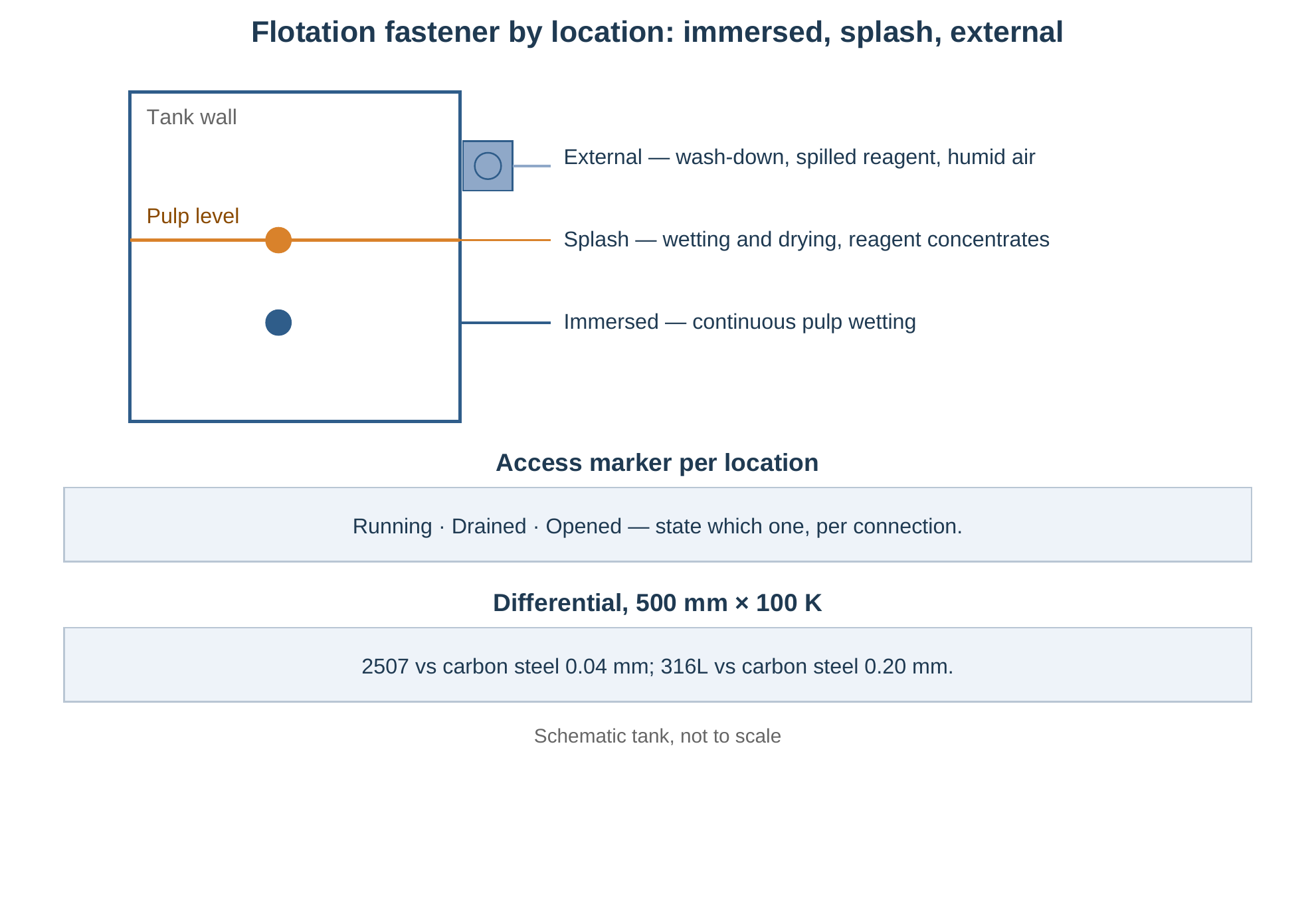
Immersed. Mechanism bolts, internal liner bolts and baffle fixings sit in moving pulp for the whole run. Most are covered by wear parts or sit behind them. The pulp chemistry sets the corrosion load, and any exposed head also sees abrasion.
Splash. At the pulp and froth level, bolts are wetted, then dried by the air and froth movement, then wetted again. Each cycle leaves salts and reagent residue in the threads and under the nut. In saline pulp, the chloride under the nut can end up several times higher than in the pulp itself.
External. Drive and gearbox mounts, launder supports and walkway bolts see no pulp. Their exposure is washdown water, spilled reagent and humid, sometimes salty air. They also need to come apart for maintenance without draining the cell.
Water quality and reagents
Process water ranges from fresh water to recycled water with rising salts, brackish groundwater and seawater. A review of seawater use in copper flotation notes that several concentrators now float copper sulfide ores in seawater because fresh water is scarce. The more chloride in the pulp, the higher the grade needed at the immersed and splash locations.
Reagents fall into collectors, frothers and pH modifiers, and the mix is set per plant. Alkaline, lime-dosed pulp is mild on stainless steel. Chloride is not, and acid circuits or acidic dosing points are harsher still. State the water source with a chloride figure, the pulp pH range, the temperature, and any reagent that is dosed close to a bolted connection.
Grade by location
| Location | Fresh water, alkaline pulp | Recycled water, moderate chloride | Brackish water or seawater |
|---|---|---|---|
| Immersed | 316L | Duplex 2205 | Super duplex 2507 |
| Splash | 316L or 2205 | 2205 or 2507 | Super duplex 2507 |
| External | 316L | 316L | 2205 near the splash zone, 316L elsewhere |
These are starting points to check against the pulp analysis, not rules.
316L is adequate wherever chloride is low and the bolt is not in a drying crevice. Duplex 2205 has a PRE above 35 against about 24 for 316L, according to Alleima's SAF 2205 data, with much better resistance to chloride stress corrosion cracking. Super duplex 2507 adds more margin again, with a PRE of at least 41 in Alleima's SAF 2507 bar data, for seawater pulp and its splash zone.
Access, galling and spares
For each connection, state whether it can be reached while the cell runs, only when drained, or only when the cell is opened. Bolts that can only be reached during a shutdown should carry the higher grade, because they will stay in place longer than planned.
Stainless and duplex threads gall when tightened dry, by the same mechanism as in nickel alloy fasteners, and galled bolts in a splash zone usually end up cut off. Use an anti-seize, and for frequently removed fixings use a nut of the same grade in a different condition or hardness; never drop the nut to a lower corrosion grade.
Order spares by location, not as a bag of mixed bolts. Mark the boxes "immersed", "splash" and "external" with the cell number, so the right grade goes back into the right hole.
| Confirm before ordering | Why it matters | Document to ask for |
|---|---|---|
| Location of each connection | Immersed, splash and external need different grades | Cell general arrangement drawing |
| Water source and chloride | Moves the grade from 316L to 2205 or 2507 | Process water analysis |
| Pulp pH, temperature and reagent dosing points | Acid and dosing points raise the corrosion load | Process datasheet |
| Access per connection | Poor access calls for the higher grade | Maintenance plan |
| Wear protection over immersed bolts | Abrasion is solved with wear parts, not alloy | Liner and mechanism drawings |
Requesting a quote
A location list is enough to start: "Fasteners for eight flotation cells, seawater pulp at pH 9–10, 25°C. Immersed mechanism bolts M20 × 120, splash-zone launder bolts M16 × 60, external drive mount bolts M24 × 100, quantities per cell attached."
Send that, and the quote comes back split by cell and location, with 2205 hex bolts, 2507 hex bolts and matching nuts where each fits.