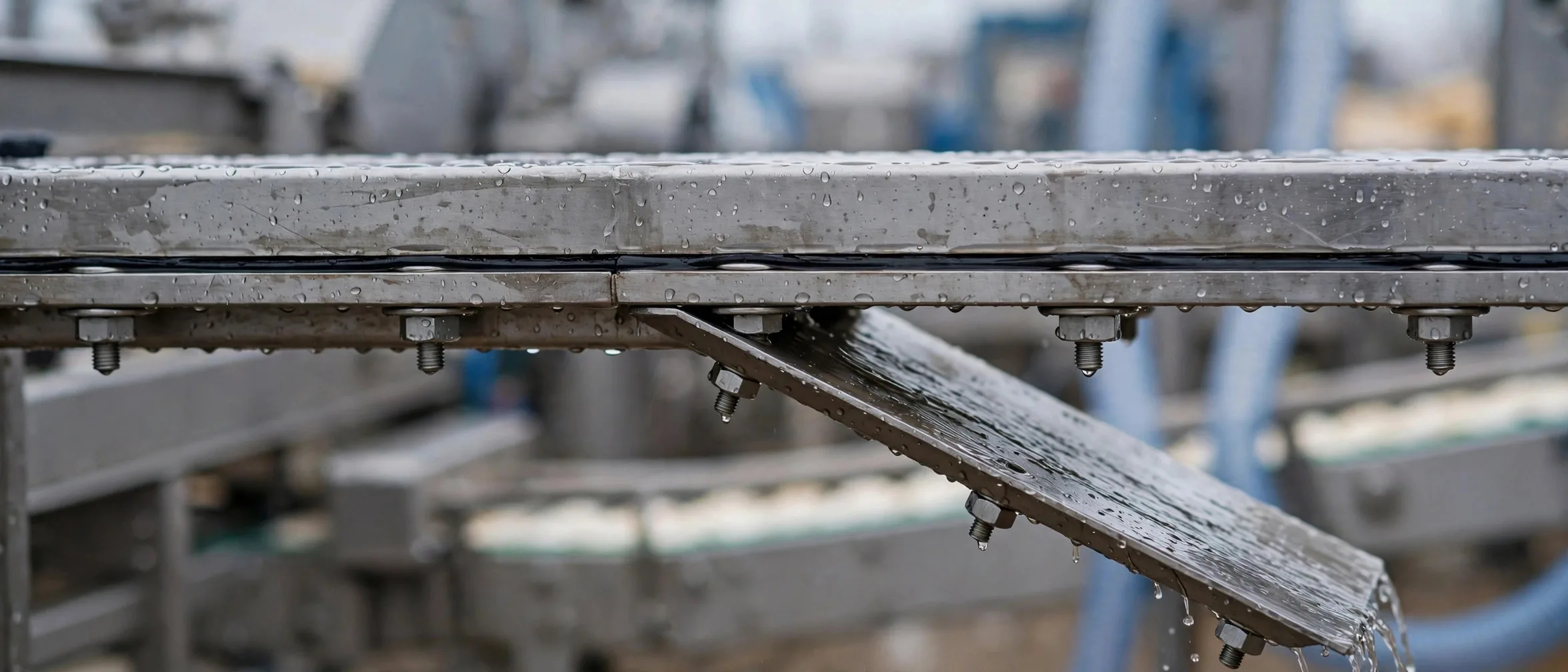
When a machine guard or motor bracket on a washdown line is hard to remove, look at two things: a seat that never drains, and a bolt the wrench can't reach squarely. A flange bolt helps with the first; the second needs clearance on the drawing.
The bearing face
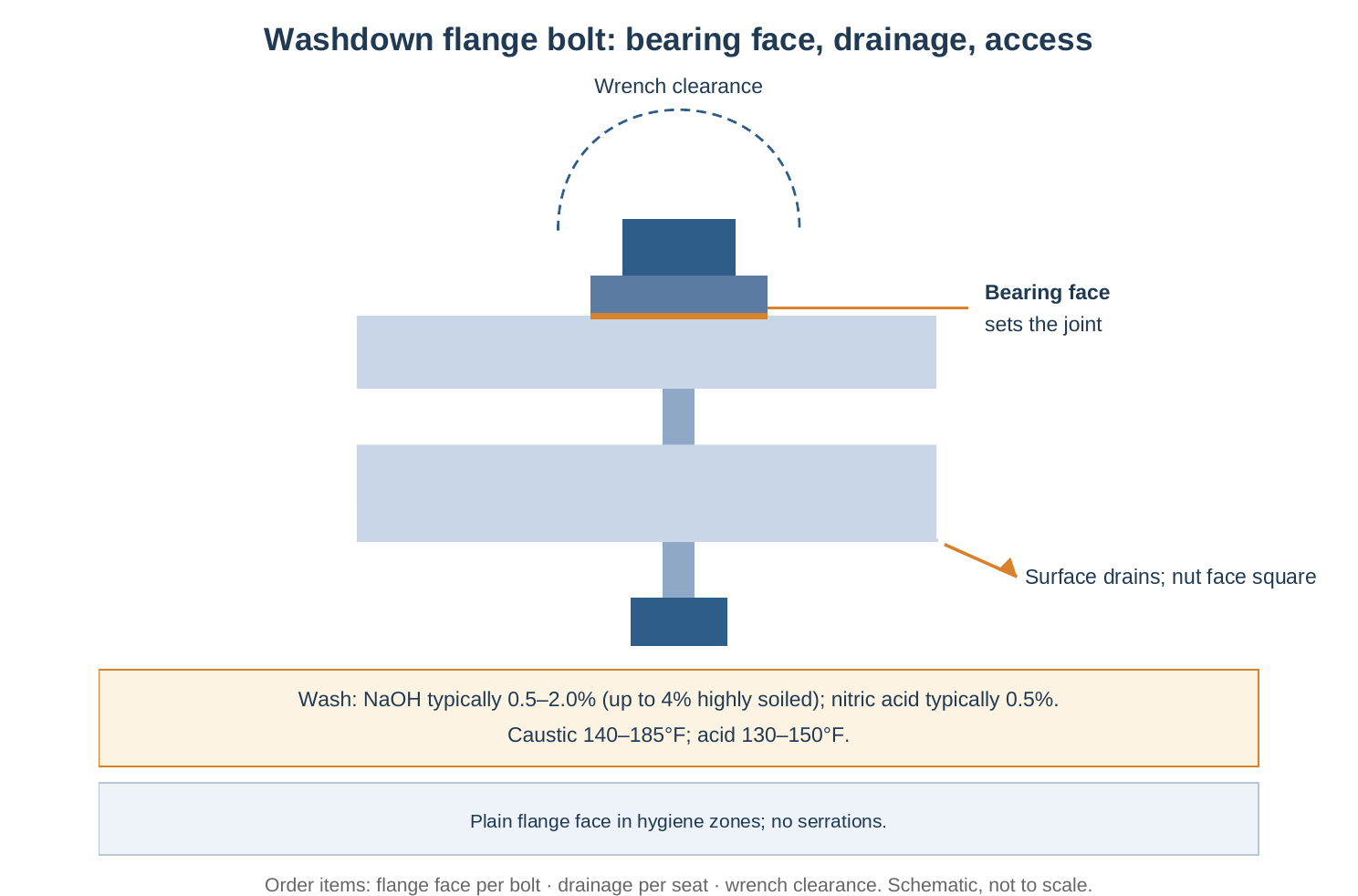
On a hex flange bolt, the underside of the flange is the bearing face. It sits directly on the parent material, with no washer and no extra interface to trap water. For each position, state:
- Flange diameter. Standard flange bolts (ASME B18.2.1, DIN 6921, ISO 4162) each have their own flange size. If the seat or spot face was machined for a particular diameter, give it.
- Face type. Plain, not serrated, in any hygiene zone. Serrations dig into stainless and leave a rough ring that holds soil. A plain flange head cleans better than a bolt and loose washer, but in a product-contact zone it is still not a hygienic seal; use a sealed fastener there.
- Parent material and thickness. On thin stainless sheet or a soft material, the flange spreads the load, but the bearing pressure still needs checking against the parent material. A bolt that sinks into the sheet loses clamp load.
- Hole clearance. An oversize hole leaves a gap under the flange that fills with soil.
Where the joint is a true pipe flange, bolting follows ASME B16.5. Machine flanges, frame rails and cover seats follow the machine drawing instead.
Access, tightening and removal
Washdown machines are taken apart for cleaning and maintenance, so every bolt that needs to come off should have room for a wrench or socket on the flange head. State the clearance where it is tight, and avoid positions where the bolt can only be reached at an angle.
Tighten to a written torque, with a food-grade anti-seize, and run nuts on at moderate speed; stainless threads driven fast with power tools can seize before they are tight. Replace flange bolts with damaged threads instead of forcing them back in.
During hygiene and maintenance checks, record by position:
- soil or residue under flanges
- standing water at seats
- corrosion or staining on flange faces
- bolts that seized or had to be cut
Drainage and wash chemistry
EHEDG Document 8 asks designers to avoid horizontal surfaces, or slope them at least 3° so liquid runs off, and to eliminate exposed threads and metal-to-metal fastener joints where they can trap soil. For flange bolts, that means:
- mount on vertical faces where possible, and slope the surrounding surface to drain, keeping the bearing face square to the bolt
- keep the thread past the nut short (one full thread is enough to show full engagement) and cap it in splash zones
- don't let water pool around the flange on horizontal rails
Then state the wash. A summary of CIP chemicals from CSI gives sodium hydroxide at 0.5–2.0% (up to 4% for heavy soil) at 140–185°F (60–85°C), and nitric acid at about 0.5% at 130–150°F (54–66°C). Open washdown often adds foam cleaners and chlorinated sanitizers. List the actual chemicals, temperatures and how often each is used.
Choosing the material
| Candidate | UNS and form | Where it fits washdown machinery | Limit to check |
|---|---|---|---|
| 316L | S31603, ISO 3506-1 A4-70 or A4-80 | Most guards, brackets, frames and covers | Chloride and heat together |
| Duplex 2205 | S32205, bar to ASTM A479 | Brine and salted-product lines; hot chlorinated washes; higher clamp loads | Cost; less readily available in small flange sizes |
| Super duplex 2507 | S32750, bar to ASTM A479 | Strong brines or seawater-based cleaning | Cost; usually only for specific positions |
316L handles caustic and acid washes well. The warning sign is chloride plus heat: the Alleima SAF 2205 datasheet notes that 316L is prone to chloride stress corrosion cracking above about 60°C, while duplex grades are far less prone. When that combination is present, duplex 2205 is the grade to move to; for ordinary loads, 316L bolts in property class A4-70 or A4-80 are strong enough.
If a machine has aluminium parts, such as housings, profiles or motor frames, a stainless bolt in aluminium speeds up corrosion of the aluminium around the hole, especially in wet, salty conditions. For a through-bolted joint, use non-conductive washers and a sleeve that isolate every contact between the stainless fastener and the aluminium. If the screw threads directly into aluminium, head washers and a shank sleeve alone do not provide electrical isolation; specify a verified isolation method or keep that joint out of the wash zone.
Requesting a quote
List bolts by machine and position, for example: "M10 × 30 316L hex flange bolts, plain face, flange Ø21, 300 pieces; guards and drive brackets on two slicing lines; 2 mm stainless sheet; caustic foam at 60°C daily, chlorinated sanitizer; removed weekly."
With the drawing and wash details, we confirm grade, dimensions and inspection and quote hex flange bolts in 316L or 2205 hex bolts. Frame and CIP fasteners have their own guides, on washdown frame bolts and CIP fasteners; the food and beverage equipment page covers the rest.