A slow pump-down after maintenance is easily treated as a leak, with hours spent on a helium detector around joints that are tight. Check the blind tapped holes too: a standard screw in one can be the source.
Trapped volumes and virtual leaks
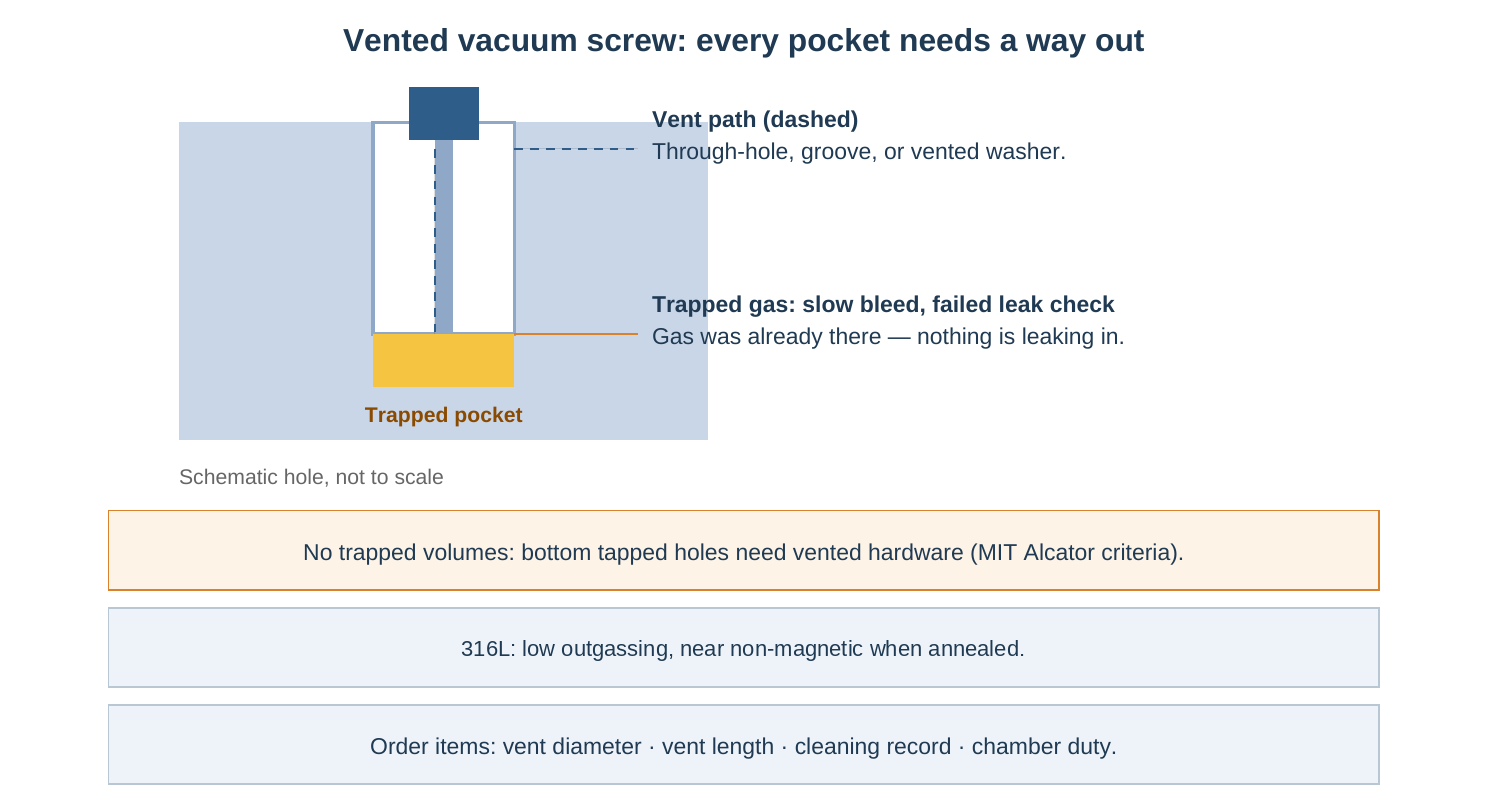
The Alcator C-Mod criteria for vacuum components, written at MIT's Plasma Science and Fusion Center, state that good vacuum design has no trapped volumes such as bottom-tapped holes without vented hardware. Trapped volumes bleed slowly into the vacuum, and the same document notes that they can make helium leak testing impossible. The rule also covers slip fits and long tubes, which need their own vent paths.
A standard screw in a blind hole leaves a small pocket of air below its tip that can only escape along the low-conductance thread clearance.
Before ordering, go through the drawing and mark:
- every blind tapped hole that opens into the vacuum side
- every slip fit or blind bore where gas can be trapped
- the vacuum level and pump-down time each chamber must meet
Vent geometry
There are three common ways to vent a screw, and the drawing should name one for each position:
- Through-bore. A hole drilled along the screw axis, from the tip into the socket. This is the most common vented socket head cap screw.
- Slotted thread. A flat or groove milled along the thread, so gas can pass the engaged length.
- Vented washer or slotted head seat. Used where the pocket is under the head rather than at the bottom of the hole.
The vent must connect the trapped pocket to the chamber and still be open when the screw is fully tightened. If a vent stops short of the bottom of the hole, or the washer seals over the head, the pocket stays trapped. State the vent diameter and tolerance, and whether the vent runs full length.
Vented screws belong in the blind holes that trap gas; there is no need to vent every screw. The vent bore removes material, so check the load capacity on the final vented geometry. Screws inside the chamber that hold light fixtures are one case; screws that compress a sealing flange, such as a CF metal-gasket joint, or carry an equipment load are another, and need the full assembly load checked against the vented section.
Material: 316L and the alternatives
| Candidate | UNS and form | Where it fits a vacuum screw | Limit to check |
|---|---|---|---|
| 316L | S31603, socket screws to ISO 3506-1 A4-70 / A4L-70 or ASTM F837 | Default for vacuum chambers and fixtures | Galling of stainless on stainless |
| Duplex 2205 | S32205, bar to ASTM A479 | Higher-load fixtures where magnetism doesn't matter | Ferromagnetic; check the chamber's material list |
| A-286 | S66286, bar to ASTM A638 or bolting to A453 Grade 660 | High-strength screws at bake-out temperature | Cost; confirm it is on the material list |
316L is the usual choice and appears on the same document's list of acceptable materials. Low carbon helps it stay sound after nearby parts are welded, and annealed 316L has very low magnetic permeability. Cold work during heading and thread rolling can raise the permeability a little, so if the application is sensitive, state the permeability limit on the order.
Duplex 2205 is stronger than annealed 316L (450 MPa minimum yield in ASTM A479 bar), but its ferrite makes it magnetic, so it is unsuitable near electron or ion beams and magnets. Where strength and low permeability are both needed, A-286 is worth considering: our A-286 socket screws combine high strength with low permeability, and A-286 keeps its strength at bake-out temperatures.
Cleaning, packaging and assembly
The same criteria require materials inside the vacuum system to be cleaned thoroughly using accepted ultra-high-vacuum practice, with ultrasonic cleaning for parts that have areas mechanical cleaning cannot reach. A vent bore is exactly that kind of area.
State on the order:
- the cleaning method: degreasing, ultrasonic cleaning, rinse and drying
- packaging: sealed bags or containers per set, so the screws stay clean
- handling: gloves, and no shop oils or marking inks after cleaning
Stainless screws in stainless threads gall easily, especially in vacuum and after bake-out, and many vacuum builders keep lubricants out of the chamber. Without a lubricant, galling is controlled by the pairing and the thread: a screw in a different alloy from the tapped part (for example an A-286 screw in a 316L block), a thread insert in the tapped hole, a good rolled thread with the right fit, and a modest, controlled assembly torque. If a lubricant is approved for the chamber, state it on the drawing.
Requesting a quote
List screws by size and vent type, for example: "M6 × 16 vented socket head cap screws, 316L, axial through-bore 1.5 mm, 400 pieces; ultrasonically cleaned and vacuum-bagged in sets of 20; chamber at 10⁻⁷ mbar, bake-out at 150°C; low permeability required."
Send the drawing with vent details and cleaning requirements, and we will quote socket screws or custom fasteners once the dimensions and inspection plan are agreed. Other tool hardware is covered on our semiconductor manufacturing equipment page.