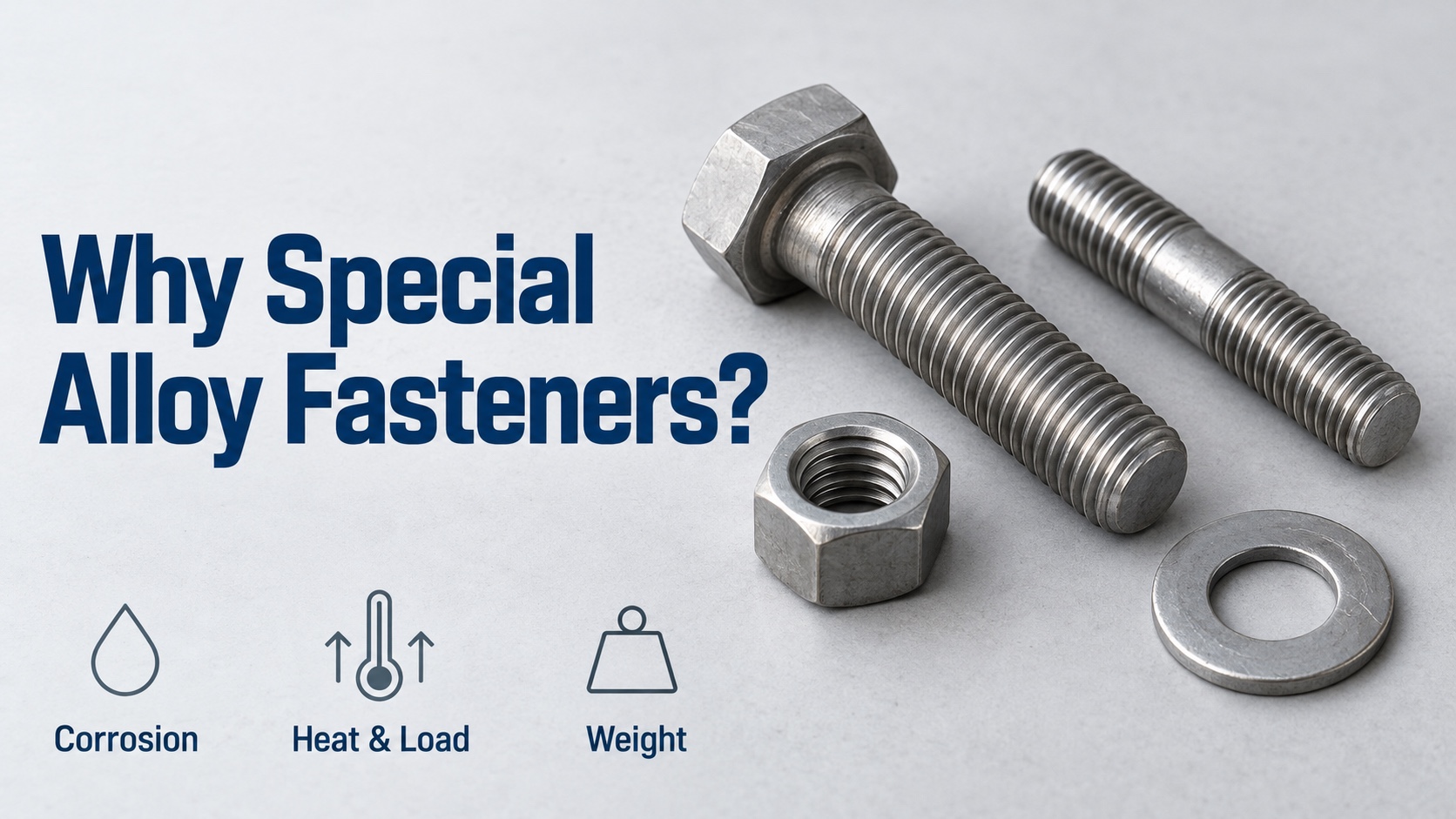
Choose stainless steel or a special alloy by the problem the fastener must solve. Keep 304 or 316 when the specified grade and condition meet the corrosion and load requirements. Investigate another material when the joint faces a more demanding chemical exposure, sustained heat, a different strength requirement or a weight constraint.
A more expensive alloy is not automatically a better fastener. Compare the exact grade, final condition and finished-part requirements against the same service conditions.
Stainless steel and special alloys: what is the difference?
Stainless steel is itself an alloy. Here, common stainless steel means grades such as 304 and 316; special alloys include selected nickel alloys, titanium materials and higher-performance stainless steels.
The categories overlap: duplex 2205 and super duplex 2507 are still stainless steels. “Special alloy” is a broad description, not a strength class or a promise of better corrosion resistance in every environment.
316 contains molybdenum, which helps in some corrosive environments. It does not make the grade suitable for every chemical or seawater condition. [1] [2]
Compare the material options
Start with the limiting condition: corrosion, heat and clamping load, or weight. If a replacement has already been proposed, go to the substitution checks.
MONEL, INCONEL and HASTELLOY are trade names. The specific grade matters more than the family name.
| Material | Selection question and next check |
|---|---|
| 304 / 316L | A familiar starting point. Use when the specified stainless grade and condition meet the exposure and load requirements. Check: For 316L, review wet crevices and aggressive media; molybdenum does not remove those risks. [1] [2] |
| 2205 / 2507 | Chlorides plus strength. Investigate duplex and super duplex when common stainless leaves a corrosion or strength gap. Check: Match the exact grade and UNS designation to chloride exposure, temperature and final condition. [3] |
| Monel 400 / K-500 | Nickel-copper options. Compare these for relevant marine or chemical duties; K-500 adds age-hardening capability. Check: Distinguish flowing water from wet gaps. With cathodic protection, review K-500 condition, loading and electrical potential. [10] [11] [17] |
| Inconel 625 | A corrosion-led nickel-alloy option. Investigate 625 against the actual chemical or seawater exposure. Check: Specify mechanical tests and acceptance limits for the supplied form and condition. [5] |
| Hastelloy C-22 / C-276 | Aggressive process liquids. Compare these nickel-chromium-molybdenum grades against the process chemistry. Check: Identify acid, concentration, temperature and oxidizing impurities; these can change which grade performs better. [4] [12] [15] |
| Inconel 718 | High strength, including hot duties. Investigate this age-hardenable nickel alloy when strength and hot-load performance drive the choice. Check: Specify final treatment, load, temperature and duration. Oxidation resistance alone does not establish retained preload. [6] |
| A-286 | An iron-based hot-fastener option. Compare this precipitation-hardened alloy where high strength and elevated-temperature duty matter. Check: Keep the actual material or bolting specification and treatment; assess corrosion and hot-load performance separately. [9] |
| Titanium Grade 2 / Grade 5 | Lower weight. Compare commercially pure Grade 2 with higher-strength Ti-6Al-4V Grade 5. Check: Review strength, stiffness, temperature, exposure and thread assembly before considering a same-size replacement. [7] [13] [14] |
What would justify changing the material?
Corrosion: identify the exposure at the joint
Name the liquid, temperature and joint geometry before choosing a grade. Salt, acidity and trapped liquid can make the conditions under a washer very different from those on an exposed surface.
- Pitting: small, deep holes in the surface.
- Crevice corrosion: attack in sheltered gaps, including under washers.
- Stress corrosion cracking: cracks that develop when tensile stress and a susceptible material meet a particular environment. [2]
A published failure-investigation abstract reports chloride stress corrosion cracking in a 316L climbing anchor in a tropical marine setting. It is a specific case, not a finding that all 316L fasteners fail near the sea. [8]
Duplex stainless steels, C-276 and 625 offer different routes to investigate. Their usefulness depends on the actual medium, temperature and exposure; the grade name alone does not settle the choice. [3] [4] [5]
Heat: check retained clamping load, not just oxidation
A bolt can resist oxidation and still lose the clamping force the joint needs. State the working temperature, load, time at temperature and thermal cycles.
Creep is slow, permanent deformation under load. Stress relaxation is a fall in stress while deformation is constrained; in a hot joint, it can reduce clamping load. Repeated loading also calls for a fatigue assessment. See the hot-joint preload guide.
718 and A-286 are candidates for hot-fastener comparisons, but their material form and heat treatment matter. The 718 bulletin covers hot strength, creep and fatigue; ATI describes different A-286 treatment routes for tensile versus creep/rupture priorities. A room-temperature tensile result does not establish hot-joint performance. [6] [9]
Weight: compare the whole connection
Titanium can reduce weight, but it is not automatically a same-size steel replacement. Review strength, stiffness, temperature and contact with other metals, as well as the nut and washer.
Include thread assembly in that review. Galling is surface damage that can make threads stick during tightening. The lighter material must still meet the connection’s mechanical and assembly requirements. [7]
Three details that can change the shortlist
- Check impurities, not just the acid name. Mishra’s tests on wrought-alloy coupons in hydrochloric acid found that ferric-ion additions changed the relative corrosion behaviour of C-22 and C-276. Ask whether oxidizing contaminants occur in the process liquid. The Hastelloy versus Inconel comparison gives the conditions and data. [15]
- Identify the actual formulation. In Santos and colleagues’ 30-day DBNPA biocide tests at 25°C and 40°C, C-276 and 625 showed no localized attack; that observation does not mean zero metal loss or resistance to every biocide. Obtain the actual fluid formulation and operating temperature before using the study in a material comparison. [16]
- Include cathodic-protection details. Martínez-Pañeda and colleagues found that K-500 cracking behaviour varied with material batch and applied electrical potential in sodium-chloride tests. Include protection potential, reference electrode, material condition and loading in the review; the Monel versus Inconel comparison explains why. [17]
These investigations belong to the cited researchers. Their test conditions limit how the findings can be used; they are not BYBOLT project records or finished-fastener acceptance tests.
Choose by exposure, not by industry label
An external bolt on a chemical vessel may never contact the process liquid. An internal fastener may be continuously immersed. Even on the same machine, the two positions can require different corrosion checks.
“Marine”, “chemical” or “high temperature” describes a starting point. The material specification needs the actual conditions at the connection.
Can a special alloy replace a stainless-steel fastener?
Only after the proposed fastener meets the requirements of that joint. Matching the diameter and thread is not enough, and a higher headline strength does not close the corrosion or assembly checks.
- Define the shortfall. Identify corrosion, cracking, hot-load loss, deformation or excess weight. If the existing stainless steel already meets the confirmed requirements, an alloy change may add little value.
- Compare the same requirements. Check exact grade, final condition, mechanical acceptance, service exposure and time at temperature.
- Review the mating parts. Include nut, washer, connected materials, threads and assembly method. [7]
- Agree the change before ordering. Resolve any deviation from the drawing or purchase specification, including tests and documents.
Compare total cost as well as unit price: inspection, maintenance and access for replacement all matter. There is no fixed service-life increase or cost saving attached to the words “special alloy”.
What to include in a comparable quotation
Send a drawing or start with the information you have. Missing details can be clarified during review.
- Part and quantity: product form, dimensions, thread and mating parts. The Hex Head Bolts and Fully Threaded Studs & Threaded Rods pages explain the geometry.
- Material and condition: current and proposed grade, specification, heat treatment or cold-worked condition, and the problem to solve.
- Service conditions: medium, concentration, contaminants, temperature, load, duration, cycling and any cathodic protection.
- Acceptance and documents: mechanical tests and limits, inspection scope, required records and deviations that need approval.
Need a material comparison for your fastener? Share the current grade, proposed alternative and service conditions. Send your drawing or written requirements.
The agreed drawing, applicable standards and quotation define the order.
Continue with your specific decision
- Nickel-copper or nickel-chromium? Monel vs Inconel fasteners.
- Aggressive process liquid? Hastelloy vs Inconel fasteners.
- 625 or 718? Compare their different roles; use the 718 specification guide to define the order.
- Other service or assembly questions? Find the next guide in the nickel-alloy fastener topic map.