Compare the grade and final condition. Start with Monel 400 for nickel-copper corrosion service, aged K-500 when that choice also needs higher strength, 625 for a broader corrosion review, and aged 718 where high strength and hot-joint performance drive selection.
A dimensional match is only the start. Compare exposure, final condition and finished-part requirements before the authorized reviewer approves a substitute. The worked marine substitution review shows how to assess an offer.
Go straight to your selection question
- Seawater or trapped liquid? Check the exposure at the joint, including the K-500 cracking question with cathodic protection.
- Chemical service? Identify the actual fluid.
- A hot, loaded joint? Check the load that must remain.
- A quotation or substitute? Compare cost on the same scope, then use the replacement brief.
Monel vs Inconel: compare these four grades first
On narrow screens, swipe the table sideways to read the source values.
| Grade and selection question | Strength example and original source |
|---|---|
| MONEL 400 UNS N04400 For nickel-copper corrosion service when the specified condition meets the load requirement. Check stagnant crevices and any cold work. [1] | MONEL 400 annealed rod/bar (room temperature) YS 172–345 MPa; UTS 517–620 MPa. Table 4, p.3. |
| MONEL K-500 UNS N05500 For a higher-strength nickel-copper option. Specify aging, then assess cracking under the actual exposure and cathodic protection. [2] [5] | MONEL K-500 hot-finished, annealed and aged rod/bar (room temperature) YS 586–827 MPa; UTS 896–1138 MPa. Table 6, p.5. |
| INCONEL 625 UNS N06625 Include in a seawater or process-chemical corrosion review. Check the offered condition, strength and sheltered wet gaps. [3] | INCONEL 625 annealed rod/bar/plate, composite sizes up to 102 mm (4 in.), room temperature YS 414–655 MPa; UTS 827–1034 MPa. Table 5, p.3. |
| INCONEL 718 UNS N07718 For high-strength hot joints. Specify aging and retained-load evidence; assess corrosion separately. [4] | INCONEL 718 15.9 mm hot-rolled round, 982°C anneal plus aging YS ≈1058 MPa; UTS ≈1313 MPa at 27°C. Table 20 and aging cycle, p.10. |
Use the figures to check the stated material condition, not to rank finished bolts. YS (0.2% offset yield strength) relates to resistance to permanent deformation; UTS is the peak tensile stress in the test. These material examples are not finished-fastener acceptance limits. Some ranges combine sizes; 718 is rounded from ksi. The original table gives full conditions; the purchase specification sets acceptance limits.
625 is normally specified without a precipitation-hardening treatment; K-500 and 718 need the agreed aging condition to obtain the quoted strength. [2] [3] [4]
A UNS number identifies the alloy, not the complete fastener specification. State the material specification, dimensions and threads, final heat-treatment or cold-worked condition, and finished-part mechanical acceptance requirements separately.
Once K-500 is selected, follow the guide to specifying K-500 bolts and nuts to define the delivery condition and acceptance records.
Which should you investigate for seawater?
For seawater, assess corrosion at the actual joint, then check strength in the proposed condition. For an existing nickel-copper design, establish whether the current requirement is 400 or K-500 before considering a replacement. If localized attack in a sheltered wet joint is the problem, include 625 in the corrosion review rather than treating a higher-strength K-500 condition as an automatic upgrade.
Special Metals reports good flowing-seawater performance for 400, with a warning about pitting and crevice corrosion under stagnant conditions. Its K-500 bulletin also describes fouling followed by pitting in stagnant or slow-moving seawater. The 625 bulletin documents resistance to localized attack and chloride stress-corrosion cracking. These separate bulletins are not a head-to-head joint test. Investigate 625 against the actual temperature, deposits, mating materials and crevice geometry. [1] [2] [3]
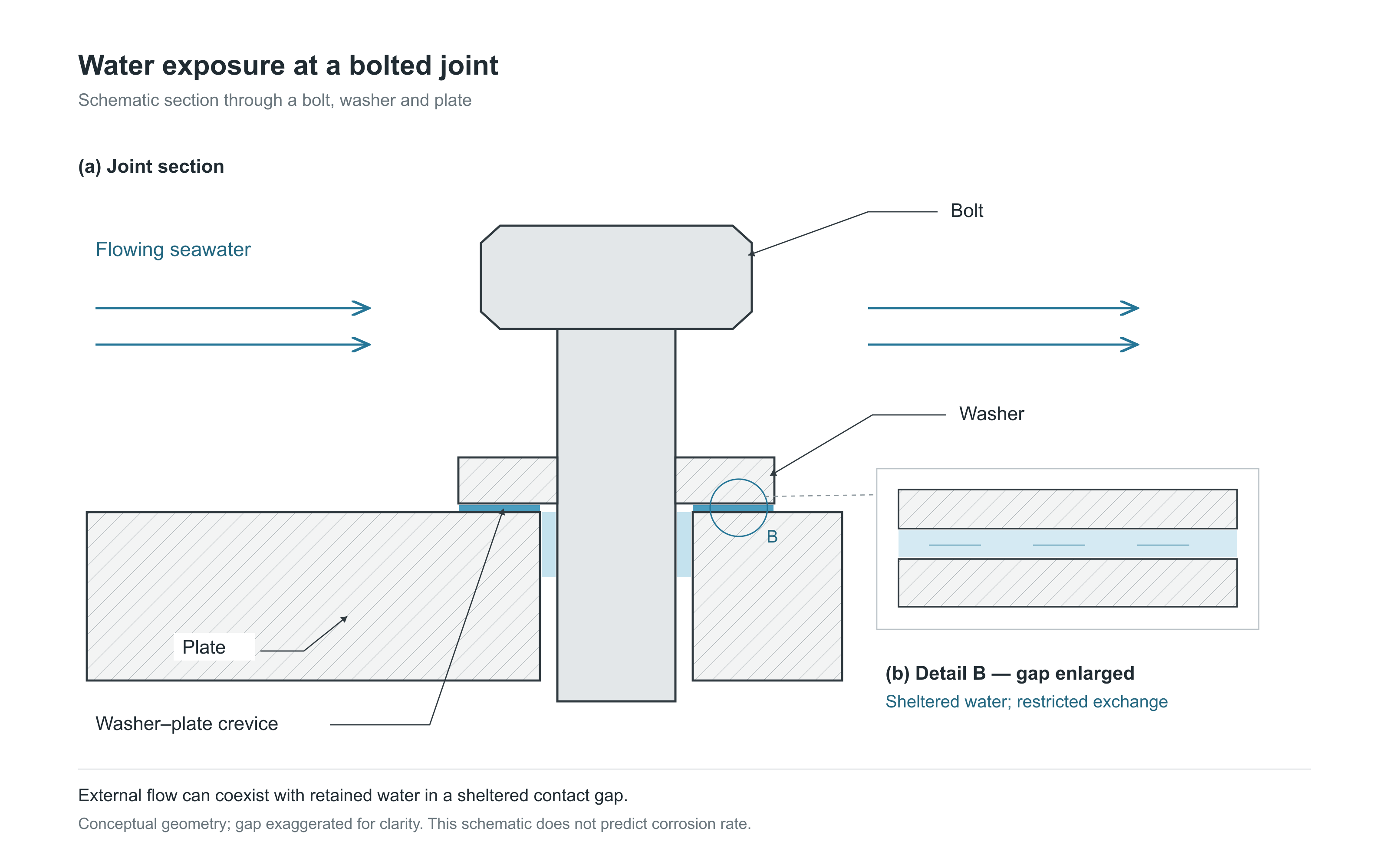
Distinguish salt spray, continuous immersion and intermittent wetting in the enquiry. Identify whether water can remain under washers or deposits and whether the assembly has cathodic protection. The seawater fastener guide develops these joint-specific questions.
For chemical service, name the actual fluid
Seawater performance does not predict resistance to every process chemical. In Santos and colleagues’ DBNPA biocide solution, 400 showed generalized attack after 30 days at 25°C and 40°C; 625 showed no localized attack in the reported immersion tests. [6] These are different corrosion observations, not a claim of zero metal loss for 625. For a dosing or storage system, identify the actual formulation, concentration, temperature and contact pattern. The study’s undiluted solution does not qualify every commercial product or loaded joint.
K-500 strength comes with a separate cracking question
Aging raises K-500’s strength, but the producer also notes greater stress-corrosion-cracking susceptibility than 400 in some environments. [2]
For a cathodically protected assembly, include the protection potential and reference electrode in the material review, alongside grade, condition and loading. Under some cathodic conditions, hydrogen can be generated and enter the metal; suppressing corrosion therefore does not settle hydrogen-cracking resistance. Name the reference electrode so the potential can be interpreted. [5]
For slow-strain-rate tensile testing (SSRT), check what its result measures.
What does a hydrogen-cracking qualification measure?
A room-temperature tensile pass does not establish resistance to hydrogen-assisted cracking. Even an environmental slow-strain-rate test needs interpretation: when the specimen finally breaks is not necessarily when its first crack started.
Martínez-Pañeda and colleagues tested four K-500 material heats using notched specimens in 0.6 M sodium-chloride solution at 25°C under controlled cathodic potentials. Fracture observations and hydrogen-diffusion analysis indicated crack growth before final failure. Their model showed that ranking heats by predicted crack initiation could differ from ranking them by final failure. [5] Read the authors’ full-text discussion.
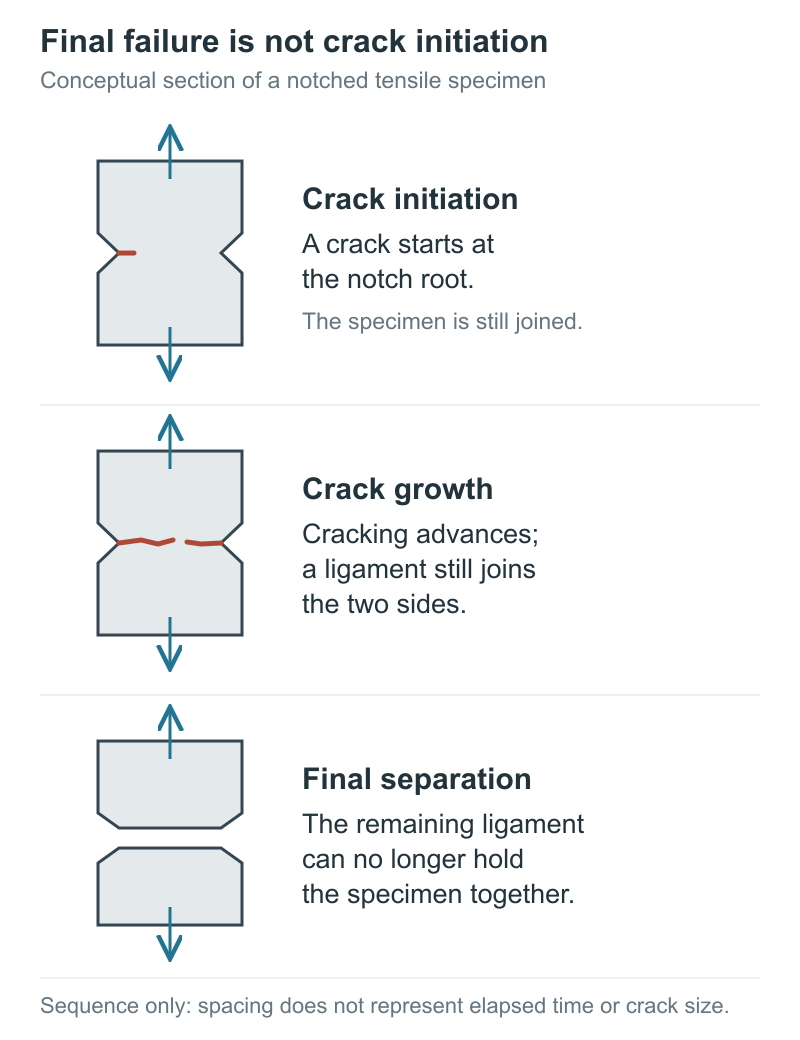
The predicted initiation times still needed direct experimental validation; they are not bolt service lives. For an SSRT-based qualification, match both the endpoint and test conditions to the question being approved.
For high temperature, compare the load that must remain
Hot tensile strength and retained clamping load answer different questions. Aged 718 is a candidate for hot fasteners [4], but sustained deformation can reduce its stress. Creep means deformation under load over time; relaxation means stress falls while the total extension is held.
A NASA-sponsored fastener study gives a more direct example. It tested 1/4-28 aged 718 point-drive bolts with Waspaloy twist-off nuts, with threads rolled after aging. The relaxation method held the distance between the bolt-head and nut bearing faces constant and recorded load. At 1200°F (about 649°C), the reported initial stress was 88.8 ksi (about 612 MPa). [7]
| Hold time at 649°C | Residual stress | Fraction of initial stress |
|---|---|---|
| 10 hours | 72.2–77.5 ksi (498–534 MPa) | 81–87% |
| 50 hours | 53.6–60.5 ksi (370–417 MPa) | 60–68% |
This is evidence from finished threaded fasteners, not an allowable retention factor for every 718 bolt. The special nut, aging condition, geometry and fixed-distance fixture matter; it was not a gasketed flange test. Do not extend a 50-hour result to thousands of hours or transfer it to Monel or 625.
Heating and cooling can also change load because the bolt and connected parts expand differently. NASA’s design manual describes both unloading and overload. [8] Specify the actual bolt temperature history, time, cycles, installation load range and minimum load required. The creep and preload guide develops the joint review; the 625 versus 718 comparison narrows the grade choice.
Which costs less?
There is no fixed Monel-to-Inconel price ratio. For competing suppliers of one specified grade, keep quantity, geometry, threads, final condition, tests and documents on the same basis. For a Monel-to-Inconel alternative, state each proposed grade and condition separately, then compare what it takes to meet the same service and finished-fastener requirements. List deviations instead of hiding them inside a lower price.
A lower price may cover different work: starting material, machining, aging, tests or documents. Ask what is included before comparing totals.
Can Monel and Inconel fasteners replace each other?
A replacement must meet both the exposure and mechanical requirements in its proposed final condition. Review mating nuts and washers, installation requirements and any dimensional changes alongside the alloy. Ask for each deviation to be stated explicitly for purchaser approval.
Worked example: is a lower-priced 625 offer enough?
Hypothetical purchasing example, not a BYBOLT supply case or a material approval.
A drawing specifies aged K-500 for an immersed marine bracket with water-retaining washer gaps and cathodic protection. A supplier offers a lower-priced 625 alternative to the same dimensions. Its proposed final condition and heat/lot are identified; assume the test object, final condition, sampling and method match the purchase requirements and offered heat/lot.
| Tensile criterion | Required / offered / decision |
|---|---|
| 0.2% offset yield strength (YS) | YS Required ≥620 MPa Offered 510 MPa Fails by 110 MPa. |
| Ultimate tensile strength (UTS) | UTS Required ≥900 MPa Offered 910 MPa Passes. |
| Elongation Same agreed method and gauge length | Elongation Required ≥20% Offered 34% Passes. |
Reject this 625 proposal as a direct equivalent: passing tensile strength and elongation does not cancel the yield-strength shortfall. The general seawater datasheet cannot resolve it either. A different condition or formally changed requirement would be a revised proposal needing its own review.
The protected-joint corrosion and cracking review is still open. Obtain the protection potential and reference electrode, then assess relevant evidence for the proposed material condition and loading. If the original K-500 basis is uncertain, review it too; rejecting this offer does not prove the original design safe.
A reviewable supplier response identifies:
- The drawing revision and quantity.
- The proposed grade, final condition and matching heat/lot records.
- Each ordered requirement, reported result and explicit deviation.
- Any missing service information and the approval needed before release.
BYBOLT deliveries include an EN 10204 3.1 material inspection certificate, heat-number traceability and mechanical testing. Test objects, methods and acceptance requirements follow the agreed order; threaded products include sampled GO / NO-GO gauging. Additional PMI or third-party inspection is agreed in the quotation. Send your drawing and service requirements for review.
Also considering 316L, duplex, A-286 or titanium? Use the wider fastener-material comparison, then return here for 400, K-500, 625 and 718. The nickel-alloy topic map connects the related service and assembly guides.
MONEL and INCONEL are trademarks of their respective owner. This comparison uses producer data and published research; neither replaces acceptance records for the ordered fasteners.