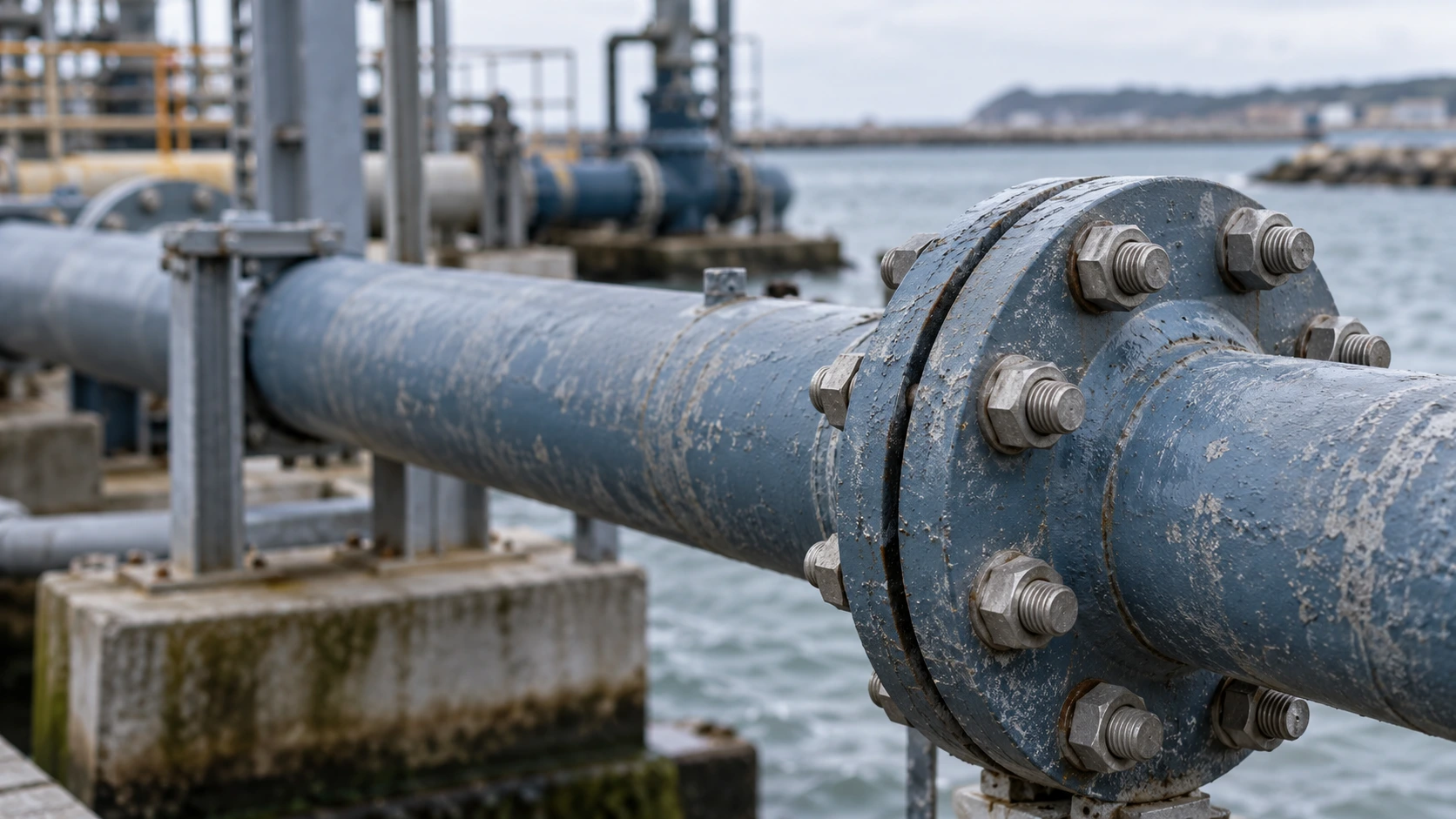
Choose a nickel-alloy fastener for the conditions at the connection—not simply because the equipment is near the sea. Before choosing a grade, identify what gets wet, where seawater can remain, which metals are connected and what load the joint must retain.
A bolt on an exposed pipe support, a submerged stud and a fastener behind a leaking flange can belong to the same installation while facing different conditions. This guide follows that local exposure through material selection, mating hardware and the information needed for an enquiry.
Start with where the seawater reaches the fastener
Marine fastener guidance distinguishes atmospheric, splash, tidal, immersed and mud exposures. Water movement, temperature and contamination also affect the assessment. “Marine service” alone therefore leaves too much open. [1]

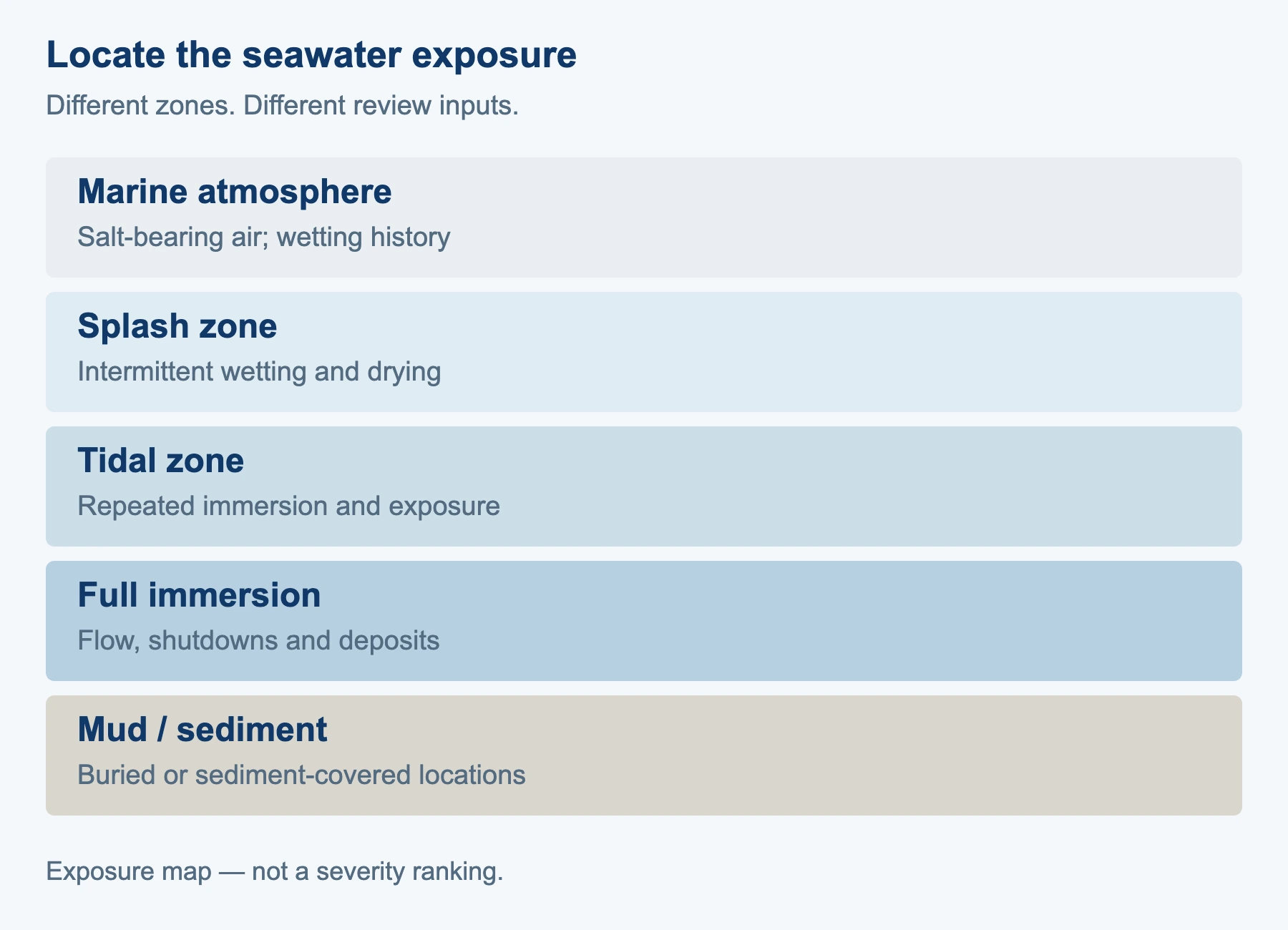
Mark the fastener location on a drawing or photograph. Is seawater inside the pipe while the bolts are normally dry outside? Does spray reach the threads? Can drainage leave a pocket wet after shutdown? These distinctions help avoid specifying every fastener from the process-fluid description.
| Record | Useful detail for the review |
|---|---|
| Wetting and drainage | Continuous immersion, occasional splash, tidal cycling, trapped water or normally dry exposure. |
| Water and treatment | Natural seawater, brackish water or process brine; available chemistry, treatment chemicals and cleaning conditions. |
| Operating cycle | Normal and upset temperatures, flow and shutdown periods, deposits and inspection access. |
| Electrical environment | Connected metals, coatings, electrical isolation and any cathodic-protection system. |
Look beneath the washer and inside the joint
A crevice is a sheltered region where liquid exchanges poorly with the surroundings. On a fastened connection, potential locations include a washer bearing face, an overlapping plate interface and a wetted thread clearance. Deposits can create additional sheltered regions. The local exposure may differ substantially from the open surface. [2]

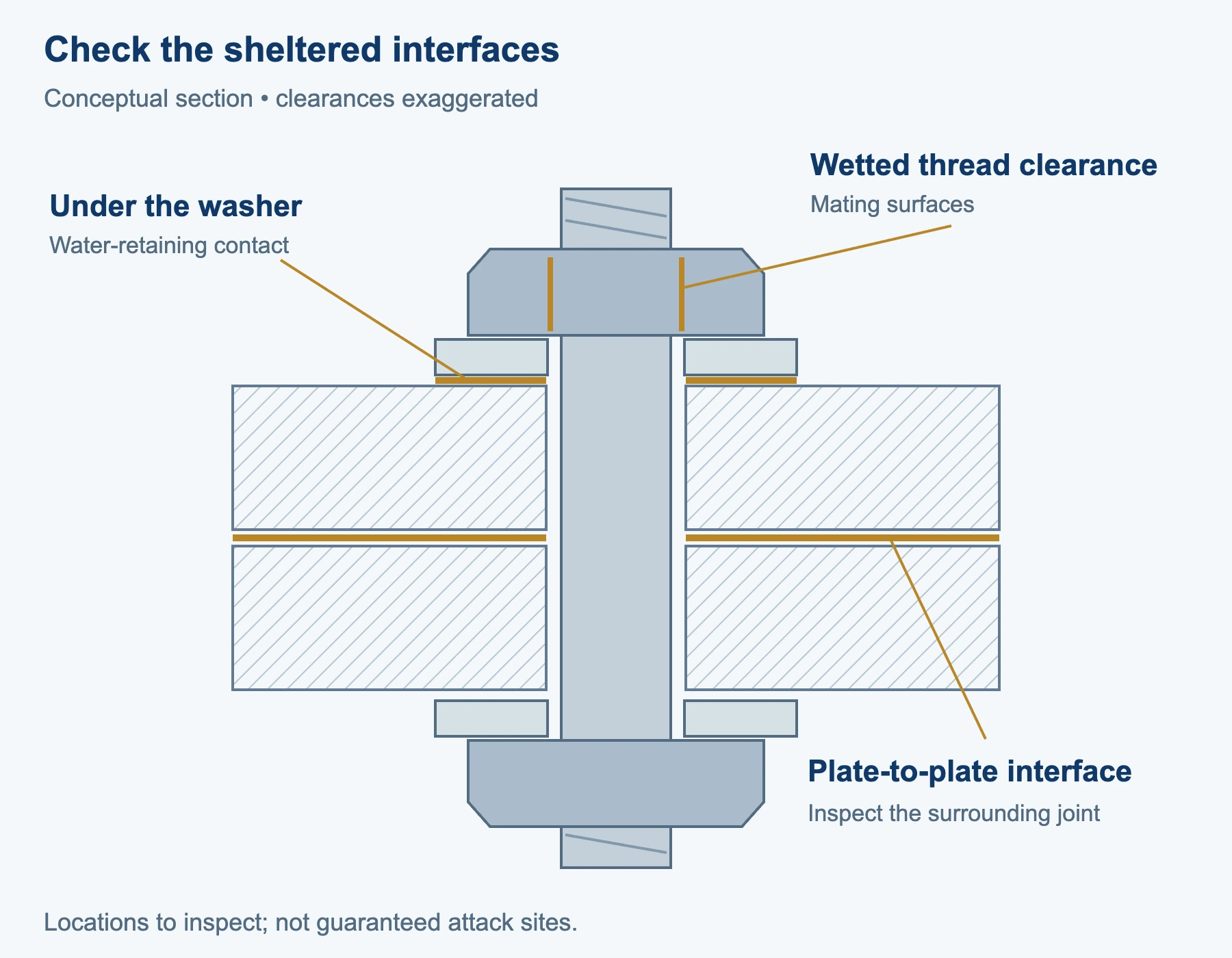
Do not read “excellent seawater resistance” as “immune in every crevice.” Special Metals’ corrosion handbook reports different Alloy 625 results for different crevice arrangements and warns about attack in very tight crevices. Its general seawater resistance remains a reason to consider the alloy, but the joint detail still needs assessment. [2] [3]
An Electrochemical Society research abstract describes Inconel 625 plate and simulated-weld specimens tested in natural seawater at controlled electrochemical potentials selected to promote crevice initiation. It identifies geometry, surface and metallurgical condition as relevant variables. Those tests establish a credible failure mechanism; they do not predict the life of an installed bolt. [4]
For a replacement enquiry, include the location of observed attack and the operating history. “Corrosion beneath the washer after repeated wet shutdowns” gives a reviewer more useful direction than “the bolt rusted.”
Review the connected metals and cathodic protection
Galvanic corrosion requires an electrical connection and an electrolyte. A resistant fastener can remain intact while a less noble adjoining component corrodes. The exposed surface areas, coating condition and actual seawater environment matter alongside the material pair. Selecting the bolt in isolation can therefore miss damage to the connection it holds. [5]
Review the stud, nut, washer, flange or plate, and any insert or sleeve together. If electrical isolation is proposed, the complete conductive path must be considered; a washer alone may leave contact through the shank or another component. The joint’s load-bearing and sealing requirements still apply.
If the structure is cathodically protected, say so before the material is selected. Nickel Institute guidance documents hydrogen-related failures of high-strength fasteners, including Monel K-500, in cathodically protected seawater structures. The applicable material condition and protection design require a specific review; this is not a reason to assign a universal safe potential or strength limit. [5]
Build a shortlist around the limiting requirement
The Inconel 625 material reference is a useful starting point where seawater corrosion is central. The producer identifies it as UNS N06625 and describes its marine applications and condition-dependent material properties. The next step is to match that evidence to the exposure and required finished fastener. [3]
Where strength is a major constraint, Inconel 718 may enter the review, with its specified precipitation-hardening condition. It should not be treated as an automatic corrosion upgrade from 625. The Special Metals handbook distinguishes their crevice-corrosion resistance in seawater. [2] [6]

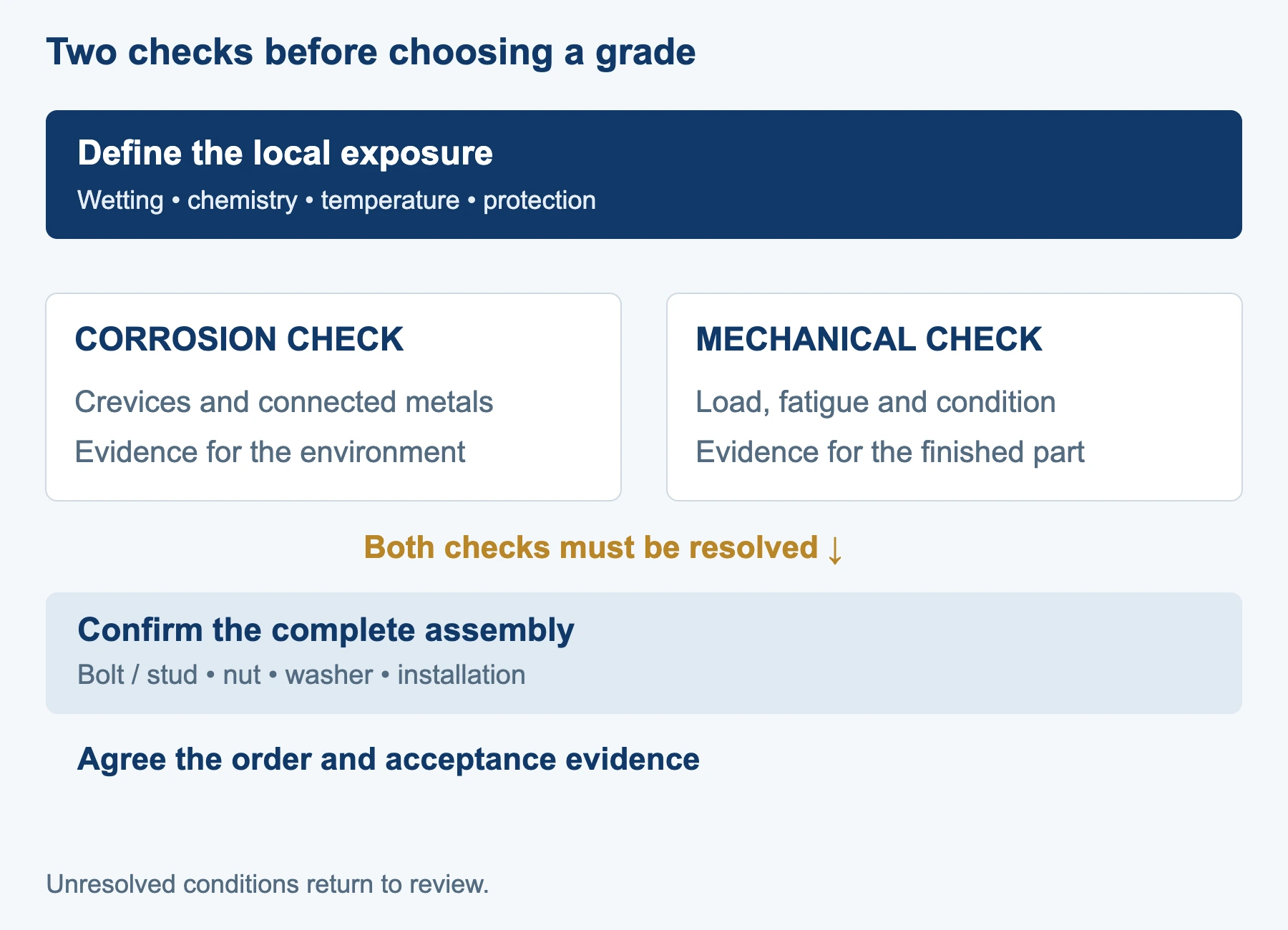
If tight crevices or other severe conditions exceed the evidence available for the shortlisted alloy, broaden the material and joint-design review. Do not assume that another nickel alloy, or a higher room-temperature strength, resolves the limiting mechanism. The existing 625 vs 718 guide explains the comparison in more detail.
Specify the complete bolted assembly
A corrosion-resistant bolt still needs the correct mating thread, nut requirements, bearing arrangement and installation procedure. Preload depends on the joint and the assembly method; friction, lubrication and surface condition affect the relationship between applied torque and bolt tension. A grade name cannot supply an installation torque. [7]
Define the nut and washer rather than leaving them as “standard accessories.” Record the lubricant or coating, cleanliness requirements and any planned reuse. Where the assembly process needs validation, agree representative testing and acceptance with the engineer responsible for the joint. The nickel-alloy galling guide covers the installation variables.
A practical review might begin with an exposed seawater-pump flange: the drawing defines the stud dimensions, the operator supplies the shutdown and cleaning history, and the engineer confirms the load and connected materials. Only then can a supplier compare a proposed material condition and evidence package against that order. This is an illustrative enquiry, not a BYBOLT project case.
Turn the service conditions into an enquiry
Send the drawing and the information already available. Missing details can be identified during review; there is no need to reconstruct a complete design specification before making contact.
- Part and joint: product form, drawing revision, dimensions, threads, mating parts and quantity.
- Local exposure: wetted surfaces, water chemistry, temperature, drainage, shutdowns, deposits and cleaning.
- Connected system: flange or plate materials, coatings, electrical isolation and cathodic protection.
- Required performance: loads and cycles, assembly method, inspection access and the governing project requirements.
- Material and acceptance: specified grade/UNS and condition, applicable material and finished-product requirements, tests, sampling and heat/lot traceability.
Use Hex Head Bolts, Fully Threaded Studs & Threaded Rods and Hex Nuts to identify the product form. For an agreed candidate, continue to specifying Inconel 625, specifying Inconel 718, or specifying Monel K-500.
Once the seawater exposure is defined, the nickel-alloy fastener selection guide connects that assessment to the material condition, mating components and finished-fastener requirements.
Keep material identity separate from proof of the finished part. The MTC, PMI and inspection-report guide helps define that evidence package. Send your drawing and service details for review →
Questions that often arise
Is Inconel 625 automatically suitable for any seawater fastener?
No. Its marine use supports considering it, but crevice geometry, material condition, connected metals and loading still need to match the evidence. A general material description is not approval of the connection. [2] [3]
Can I replace only the bolt and keep the existing nut?
That requires a review of the proposed pair: mechanical requirements, thread fit, corrosion exposure and assembly behaviour. Include the existing nut and washer in the enquiry rather than assuming compatibility. [7]
Does an uncorroded bolt mean the joint is sound?
No. Inspect the surrounding plate, flange and bearing region as well. Galvanic attack can affect an adjoining component while the fastener looks intact. [5]
Evidence scope
This focused technical review uses marine-fastener guidance, producer literature, a published research abstract and a fastener-design manual. Material data and controlled specimen tests inform the review; the actual connection and purchase requirements determine acceptance. Sources checked on 19 October 2026.