A quotation marked “304/304L” may be perfectly reasonable, but the slash is not the evidence. The purchasing question is whether the delivered material meets the requirements of both grades under the specified product standard—and whether those requirements cover the part you are buying.
What is the practical difference?
304L is the low-carbon variant of 304, chosen particularly when welding and subsequent corrosion exposure make sensitization a concern. The identities are UNS S30400 for 304 and S30403 for 304L. Carpenter describes 304L with a maximum of 0.03% carbon to reduce carbide precipitation during welding. [1] [2]
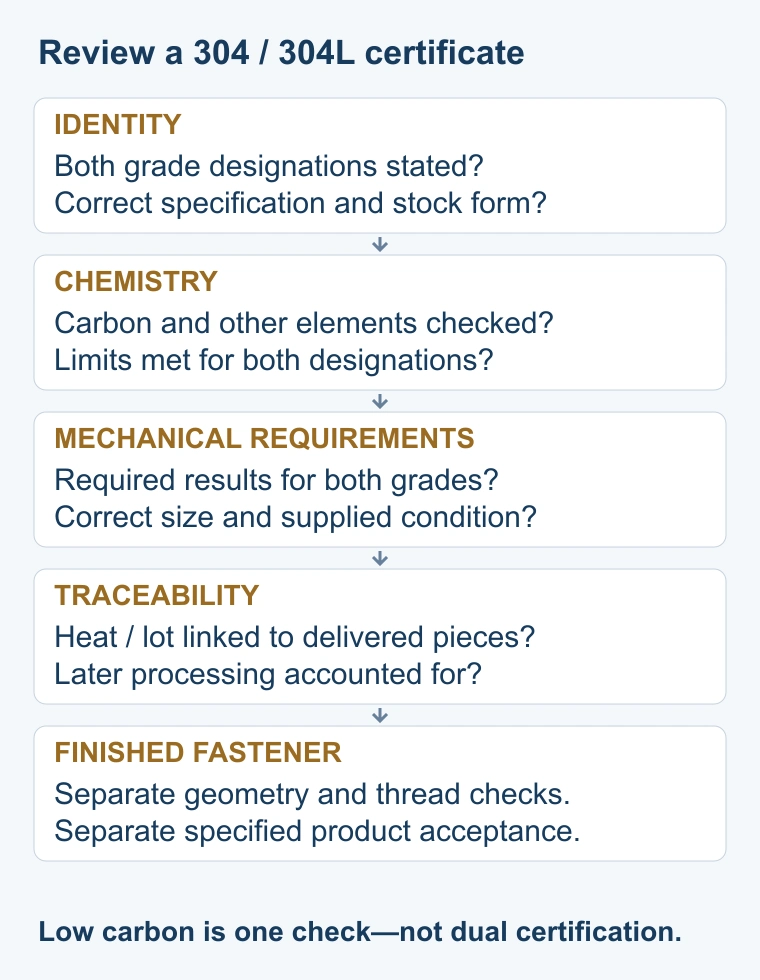
Dual certification requires the relevant requirements for both designations to be satisfied. Low carbon alone does not prove that, and a certificate for raw stock does not automatically certify the finished fastener’s geometry or mechanical performance.
Read the carbon limit with the product specification
| Item | 304 | 304L |
|---|---|---|
| UNS | S30400 | S30403 |
| Carbon maximum in this cited table, mass % | 0.07 | 0.030 |
| Main purchasing distinction | Verify the ordered grade and the applicable product requirements. | Verify the low-carbon requirement as well as the other ordered requirements. |
These are the values in ATI’s cited flat-product table, not a universal chemistry limit for every 304 or 304L item. Use the specification and edition that govern the ordered form when checking acceptance. ASTM A240/A240M addresses plate, sheet and strip; A276/A276M addresses bars and shapes. [1] [4] [5]
On a purchase order, keep “grade”, “product form” and “material specification” in separate fields. This prevents a plate-data comparison from silently becoming the acceptance basis for a bar, wire or finished bolt. Outokumpu’s Core catalogue is useful for identifying grade variants and forms, while the order still needs its own explicit requirements. [6]
Why welding changes the decision
Weld heating can promote chromium-carbide precipitation and leave susceptible grain-boundary regions. ATI explains that reducing carbon delays harmful sensitization and favors 304L for relevant as-welded service; it does not eliminate the reaction during prolonged exposure. [1]
Ask whether the purchased item itself is welded, whether heat treatment follows, and what environment it sees in service. A welded plate fabrication and an unwelded hex bolt used to assemble it have different manufacturing histories. The presence of a weld somewhere in the assembly does not answer the bolt’s material or property requirements.
Likewise, selecting 304L does not establish a higher finished-fastener strength class. If an existing drawing requires 304, a proposed 304L substitution must be checked against all controlling requirements, including mechanical requirements and condition. If the issue is broader material selection, begin with stainless steel versus special-alloy fasteners.
What a dual-certified certificate needs to show
Treat dual certification as a claim about one identifiable supplied material or lot meeting two sets of requirements. It is not two unrelated certificates stapled together, and it is not a promise that any 304L product can be relabeled 304.
| Evidence | Question to resolve |
|---|---|
| Identity and scope | Does the document identify both grades, the governing specification/edition, product form and condition? |
| Heat chemistry | Are the relevant results reported and within the applicable limits for both designations—not just the carbon limit? |
| Mechanical results | Do the required tests satisfy both sets of requirements for the certified form, size and condition? |
| Traceability | Can the certificate’s heat/lot be connected to the pieces delivered and any subsequent processing? |
| Finished-part release | If buying a fastener, where are the agreed dimensional, thread and finished-part acceptance results? |
For example, a certificate showing 0.02% carbon may support the low-carbon check, but it does not by itself show the mechanical requirements, all other chemistry limits or traceability. If only 304L is certified, ask the supplier to substantiate the proposed dual designation; do not create the second certification in your receiving record.
Why an XRF “304” result cannot establish 304L
Handheld XRF cannot measure carbon. A result identifying the chromium-nickel family therefore cannot establish the low-carbon suffix. Thermo Fisher distinguishes this limitation from carbon-capable OES and the carbon-capable LIBS equipment discussed in its application note. [3]
When carbon verification is required, state the measurement method and its suitability for the expected range, surface preparation, sampling and acceptance rule. Do not write only “PMI required” and assume every instrument answers the same question. Chemistry verification also does not measure finished-part strength.
Use the MTC, PMI and inspection-report guide to assign each acceptance question to the right document or test. Appearance, finish and a generic “stainless” description do not replace that evidence.
Write the acceptance route into the enquiry
For a plate fabrication, a useful starting note is: “304L, UNS S30403, plate to the agreed edition of ASTM A240/A240M; specify thickness, delivery condition and required documents. Any dual 304/304L designation must be supported by the material certificate.” Complete the dimensional and fabrication requirements on the controlled drawing.
For a machined fastener, change the material route to the actual feedstock and keep the finished-part requirements separate. Do not retain A240 merely because it appeared in a plate comparison. If the order includes nuts or washers, define and verify each component rather than assuming the bolt’s certificate covers the whole set.
- Confirm whether the order requires 304, 304L or expressly accepts documented dual certification.
- State product form, size, condition, specification and edition before comparing quotations.
- Identify any welding or further processing that affects the supplied condition.
- Define heat/lot traceability and which material and finished-part documents are required.
- If independent carbon verification is needed, agree its method and acceptance criteria before dispatch.
The 304 and 304L material pages provide grade reference information. Use plate and sheet for a flat-product enquiry, or round bar for machining stock. For finished hardware, start with hex bolts or nuts and include the drawing. Send the required designation, quantity and acceptance documents through Request a quote.