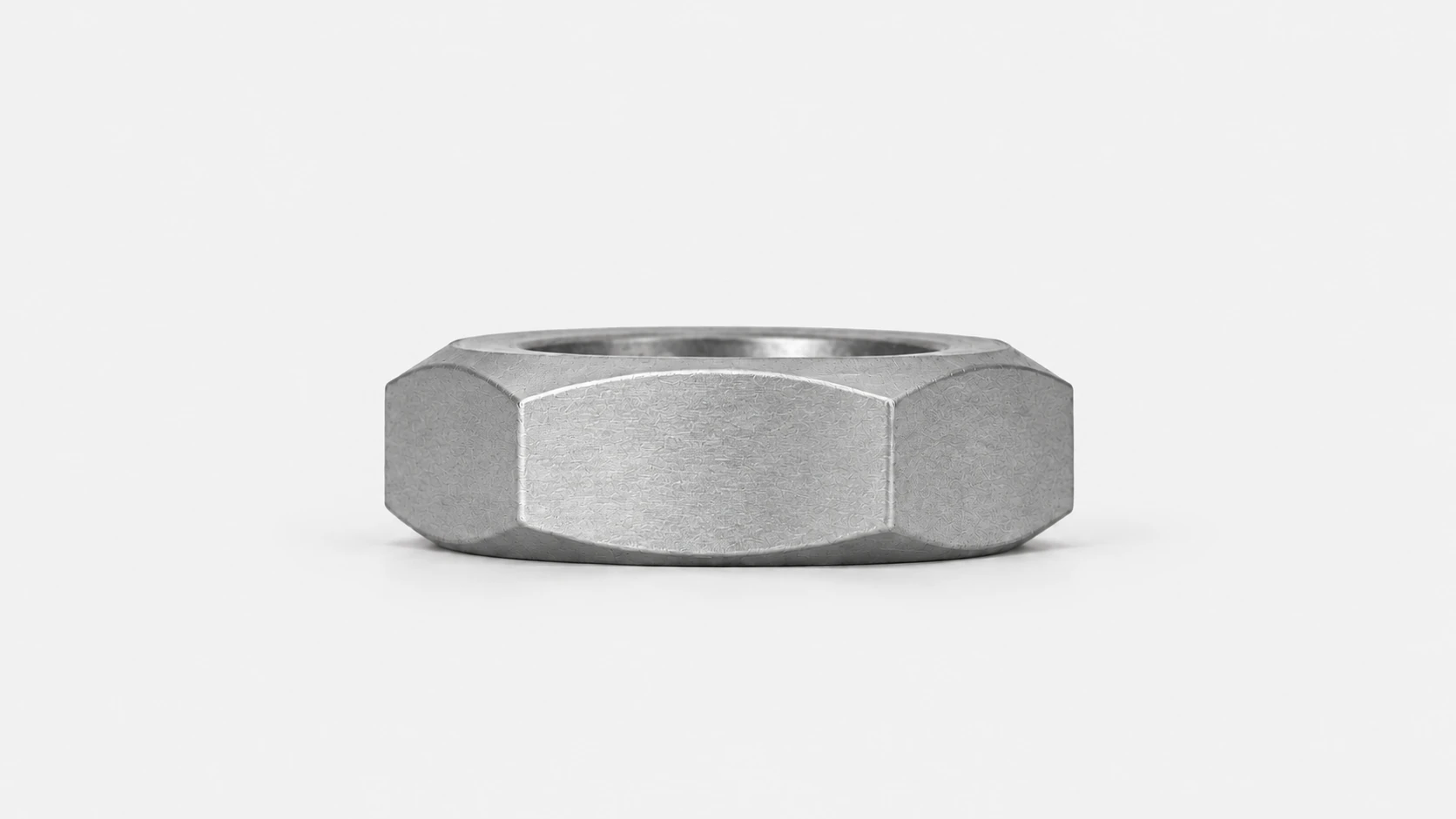
A thin nut is a possible response to limited space, but changing a specified regular nut to a thin nut requires an approved change to the assembly requirements. Matching the nominal thread diameter and pitch is insufficient.
ISO 4035 identifies thin nuts as a reduced-loadability form. When they serve as jam nuts, the standard calls for their use with a regular or high nut. A buyer reviewing a substitution should therefore confirm the nut’s role, the required load-carrying performance and the available space together. [1]
What changes between ISO 4032 and ISO 4035?
The two standards identify different nut forms. Their shared thread designation does not make the complete parts equivalent.
| Nut form and published scope | Purchasing implication |
|---|---|
| ISO 4032:2023 — Regular hexagon nut, style 1. Its main scope covers steel and stainless steel, metric coarse threads M5–M39, and product grades A and B. | Retain the specified regular form unless a change is approved. The standard also refers sizes outside its main range to an annex; check the applicable requirements before ordering. |
| ISO 4035:2023 — Thin hexagon nut, style 0. Its scope covers steel and stainless steel, metric coarse threads M1.6–M64, and product grades A and B. | A thin nut has less load-carrying capacity than a regular or high nut. The standard warns that this form is not designed to resist thread stripping—failure of the engaged threads. |
These are the published standard scopes, rather than a stock or supply list. The A/B labels are product grades; specify the required mechanical properties separately. For enquiries, the existing hex nut and thin hex nut pages cover the respective product forms. [1] [2]
Why is matching the thread insufficient?
The thread designation helps define how the mating parts fit. The nut’s load-carrying capability also depends on its geometry and mechanical properties. Reducing the height changes the threaded region available to carry the load; a successful fit check alone cannot establish that the replacement meets the original assembly requirement.
Overall nut height is also not a measurement of complete, effective thread engagement. Chamfers and the thread ends can affect which portions of the mating threads are fully engaged. Use the actual nut and mating-part geometry for the assessment instead of turning a photograph or a nominal height into a load rating.
Where the enquiry is missing a thread tolerance class, use the metric and Unified thread-class guide to define that input. Thread fit and load acceptance remain separate checks.
Does using it as a jam nut resolve the question?
It changes the assembly being proposed. ISO 4035 describes a jam-nut application with a regular or high nut; it does not establish that a thin nut on its own replaces the load-carrying nut. [1]
For a two-nut proposal, check the space for the complete arrangement, the available mating thread and the approved assembly procedure. Specify the nut order and tightening method in the approved assembly procedure. A generic “jam nut” description is insufficient to select an installation order, torque or locking performance for a particular connection.
A space-limited order: what should the buyer change?
Suppose a cover cannot close over a specified stud-and-nut assembly. First locate the contact: is the nut body in the way, or does the stud end project into the cover? A shorter nut alone does not shorten the stud. If the nut body is the obstruction, compare the proposed nut geometry with the available space before submitting the change. This is a hypothetical purchasing example, with no assumed load value or approved substitute.
- Keep the original requirement visible. Retain the drawing revision, nut form, complete thread designation, material condition and finished-part acceptance requirements.
- Describe the space conflict. Identify whether the conflict is axial height, radial clearance around the hexagon, or access for the wrench or socket. Show the available space and the mating parts. A thinner form is useful only if its actual dimensions resolve the identified conflict; check tool access separately.
- Submit the alternative for a defined decision. Ask the responsible designer to assess the proposed nut and complete assembly against the required load and service conditions.
- Update the controlled order after approval. Record the accepted geometry, material, inspection requirements and assembly instructions together, so the quotation and supplied parts follow the same decision.
If the alternative does not meet the requirement, the space conflict remains a design issue. Retaining the same thread designation while silently changing the nut form leaves that issue unresolved.
What if the nut is Inconel 718 or A-286?
A special-alloy designation adds a material and condition requirement. It does not, by itself, establish that a thinner form will satisfy the original connection’s load requirement.
ISO 898-2 covers specified property classes for non-alloy and alloy steel nuts, with mechanical testing at 10–35°C. Its published scope also warns against assuming that those properties remain unchanged at other temperatures. Do not transfer a steel-nut property class or a room-temperature result into an Inconel 718 or A-286 service rating. [3]
For a special-alloy nut, state the intended dimensional reference or approved drawing, alloy, delivery or heat-treatment condition, finished-nut acceptance basis and relevant service conditions. Resolve the applicability of those requirements together. Merely choosing a higher-strength material does not document approval of the changed geometry.
What should accompany the enquiry?
Send the original nut requirement, the mating bolt or stud, the space constraint and the proposed change. A marked drawing is useful; written dimensions and a description can start the enquiry when no drawing is available. Identify any assembly-load or service requirement that still needs a decision.
BYBOLT deliveries include an MTC / EN 10204 3.1 certificate, heat-number traceability and mechanical testing. Threaded products include sampled GO / NO-GO gauging. The agreed specification defines the test objects, methods, sampling and acceptance criteria; additional PMI or third-party inspection is agreed separately.
Check that the documents cover the acceptance requirement actually ordered. A thread-gauge result checks the specified thread feature; material chemistry or a material tensile result is not a finished-nut proof-load result. The MTC and inspection-report guide explains how to distinguish those records.