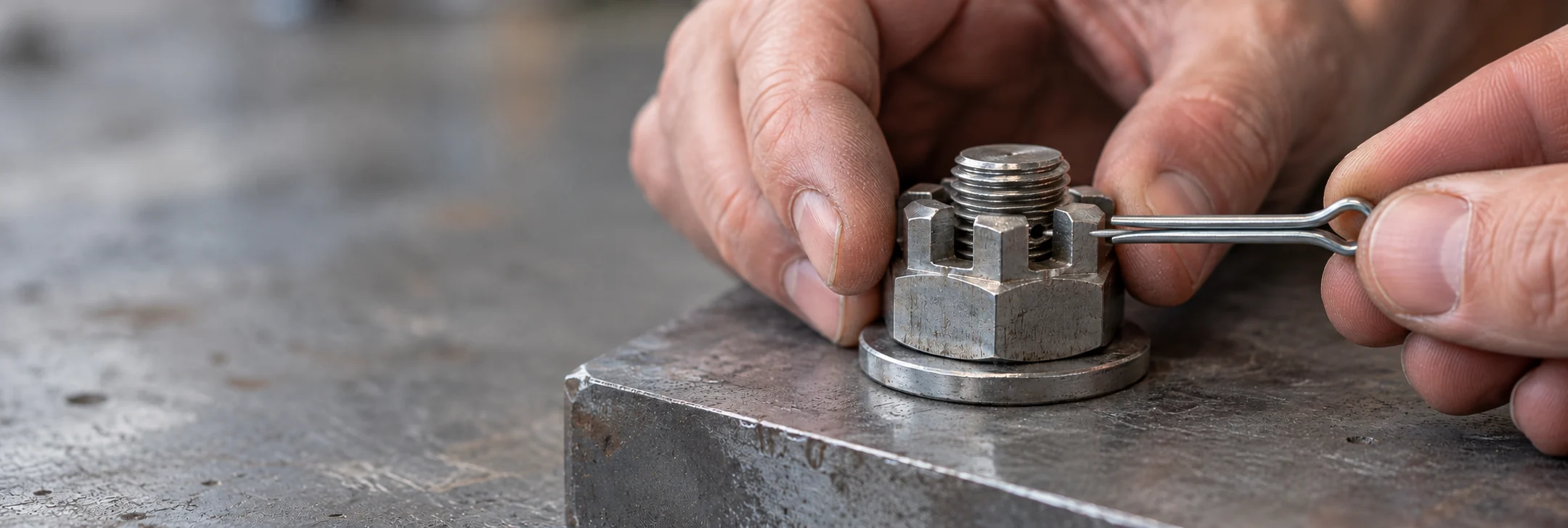
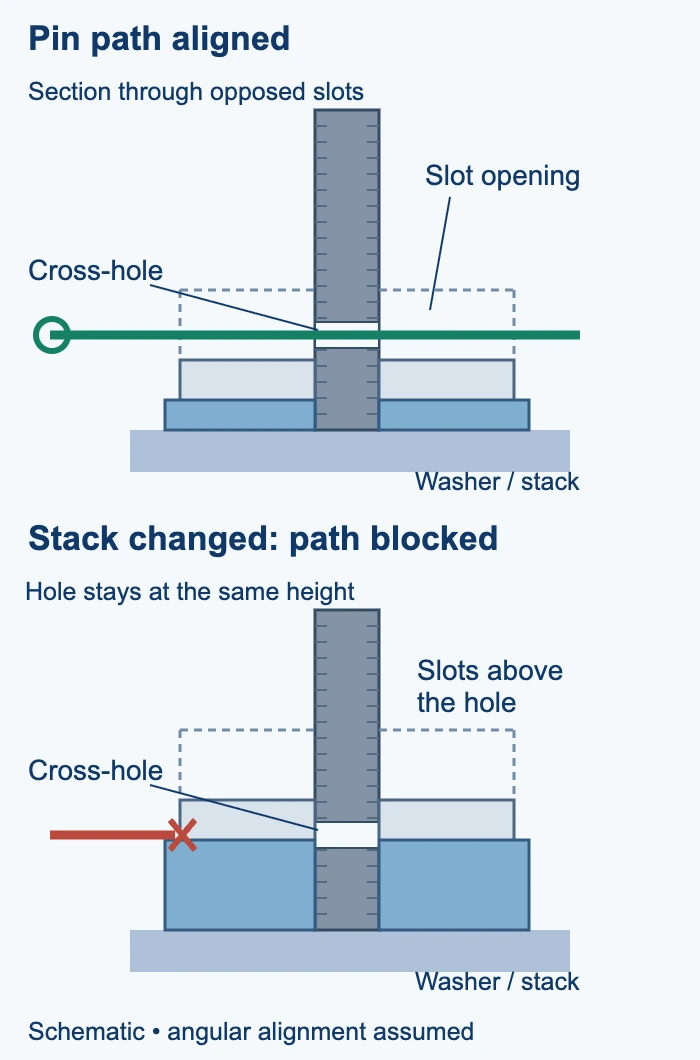
If the cotter pin will not pass through a castellated nut, check two things: whether a slot faces the cross-hole, and whether the slot opening overlaps the hole axially at the required assembly setting. Rotating the nut can address the first question; a hole sitting above or below the usable slot points to a different fit or stack problem.
Set the joint as its equipment procedure requires, then complete the specified pin retention. Whether alignment permits further tightening or a prescribed back-off depends on what that nut adjusts. Actual manufacturer examples below show why those instructions differ.
How the pin restrains the nut
The cotter pin passes through a pair of nut slots and the cross-hole in the bolt or stud. Once retained in place, it obstructs rotation of the nut relative to that drilled part: the slot wall meets the pin instead of allowing the nut to turn freely. Clearance in the parts remains, so this is mechanical retention rather than a way to set an exact clamp load. NASA’s Figure 6 shows this physical arrangement. [1]
The assembly sequence has two distinct results to achieve: first the required tightening or bearing adjustment, then a usable pin path and the specified pin retention. When those conflict, the equipment procedure determines the remedy. An adjustment nut on a bearing and a preloaded clamping nut can have different setting requirements even though both use a cotter pin.
Should you tighten further or back off?
Start with the component being secured; the permitted alignment method differs between these examples:
- MOOG steering/suspension: Set the castle nut to the specified torque. If necessary for pin alignment, the nut may be tightened slightly further; do not back off. MOOG also requires a secure stud fit in the receiving hole. [3]
- Conventional tapered-roller truck wheel ends: Timken’s RP 618A sheet includes prescribed back-off steps to set and check end play in the conventional systems it covers. [4]
- Timken Set-Right pre-adjusted wheel ends: The separate procedure in the same sheet says not to back off. “Wheel bearing” alone does not identify which procedure applies. [4]
Identify the assembly and use its specified sequence, limits and final check. A steering-joint instruction cannot be transferred to an adjusting bearing, and a conventional bearing procedure cannot be transferred to a pre-adjusted system. These examples explain the choice of procedure; their torque and adjustment values are not specifications for an unrelated industrial connection.
Check the whole pin path
The pin must have a clear path through the relevant nut slots and the cross-hole in the mating fastener. A slot that appears aligned from one viewing angle may still be too high or low relative to the hole, or may not provide clearance through the complete path.
| Check | Required drawing information | What a thread match misses |
|---|---|---|
| Angular alignment | Slot arrangement and the permitted alignment method at the specified assembly setting. | A nut can thread on but stop between usable slot positions. |
| Axial overlap | Cross-hole location from a defined datum, nut slot geometry, nut height and installed washer/stack dimensions. | The pin hole may sit outside the usable slot opening after seating. |
| Pin and access | Specified pin form, diameter, length and material; hole/slot clearance and space for installation and inspection. | A nominally suitable pin may not pass or allow the specified retention to be installed in the available space. |
Do not substitute a nut name for geometry
“Slotted nut” and “castle nut” are not enough information to approve a substitution. ASME B18.2.2-2022 has separate dimensional tables for hex slotted and hex castle nut forms, along with slot-gaging provisions in its published contents. The shared retention idea does not make the table dimensions interchangeable. [2]
Order the defined form and controlling edition, or provide an approved drawing. Check the slot opening relative to the bearing face and the complete mating hole position. Do not assume a replacement nut will restore alignment solely because its thread and wrench size match.
Review the stack at the approved setting
Hypothetical replacement enquiry. A buyer retains the original cross-drilled stud but proposes a nut from another family and a thicker washer. Both replacement parts fit over the thread. The changed bearing-to-slot dimension and stack move the nut’s slot openings relative to the fixed cross-hole.
Review the proposed nut and washer together against the original assembled datums and tolerances. The consequence is a possible alignment conflict, not a proven failure of every thicker washer or alternative nut. Resolve the actual dimension chain before approving the substitution.
If the pin path does not align at the required setting, follow the equipment’s approved method for resolving it. There is no universal permission to loosen the nut, add torque, grind a slot, drill another hole or swap washer thickness. Such changes can alter adjustment, preload, engagement or component strength.
Separate retention from clamp-load acceptance
A pin passing through the hole shows that a geometric path exists at that position. It does not show that the nut was set to the correct preload, bearing adjustment or other assembly requirement. Establish the required setting using the approved procedure, then complete and inspect the specified retention arrangement.
Use the specified pin form, size and material, including the equipment’s replacement rule. MOOG’s example calls for inserting the pin fully through the aligned path and bending its legs back to retain it. Inspect the complete path and retention in the actual assembly; a wire that merely fits through the hole is not a defined replacement pin. [3]
Can the cotter pin be reused?
For reassembly, plan a new pin of the specified form, size and material. The FAA’s aircraft-hardware discussion on its Cessna T310Q lessons-learned page, for example, treats the cotter pin as a one-time-use item requiring replacement after removal. For industrial maintenance, check the equipment’s replacement instructions and include the matching pins in the service order, rather than assuming that a removed bent pin can be refitted because the nut remains usable. [5]
Send a paired definition
For a slotted/castle-nut enquiry, provide the nut drawing or standard/edition and the cross-drilled mating-part detail. Identify the hole’s axial datum and size, the installed washer/stack, and the pin specification. Include the intended assembly setting and alignment/retention procedure when assessing an alternative.
For a custom drilled fastener, locate the hole through the controlled drawing instead of requesting “a hole near the end.” Inspection should establish conformity of the nut, drilled part and pin to the agreed requirements; trial assembly alone does not establish their material properties.