
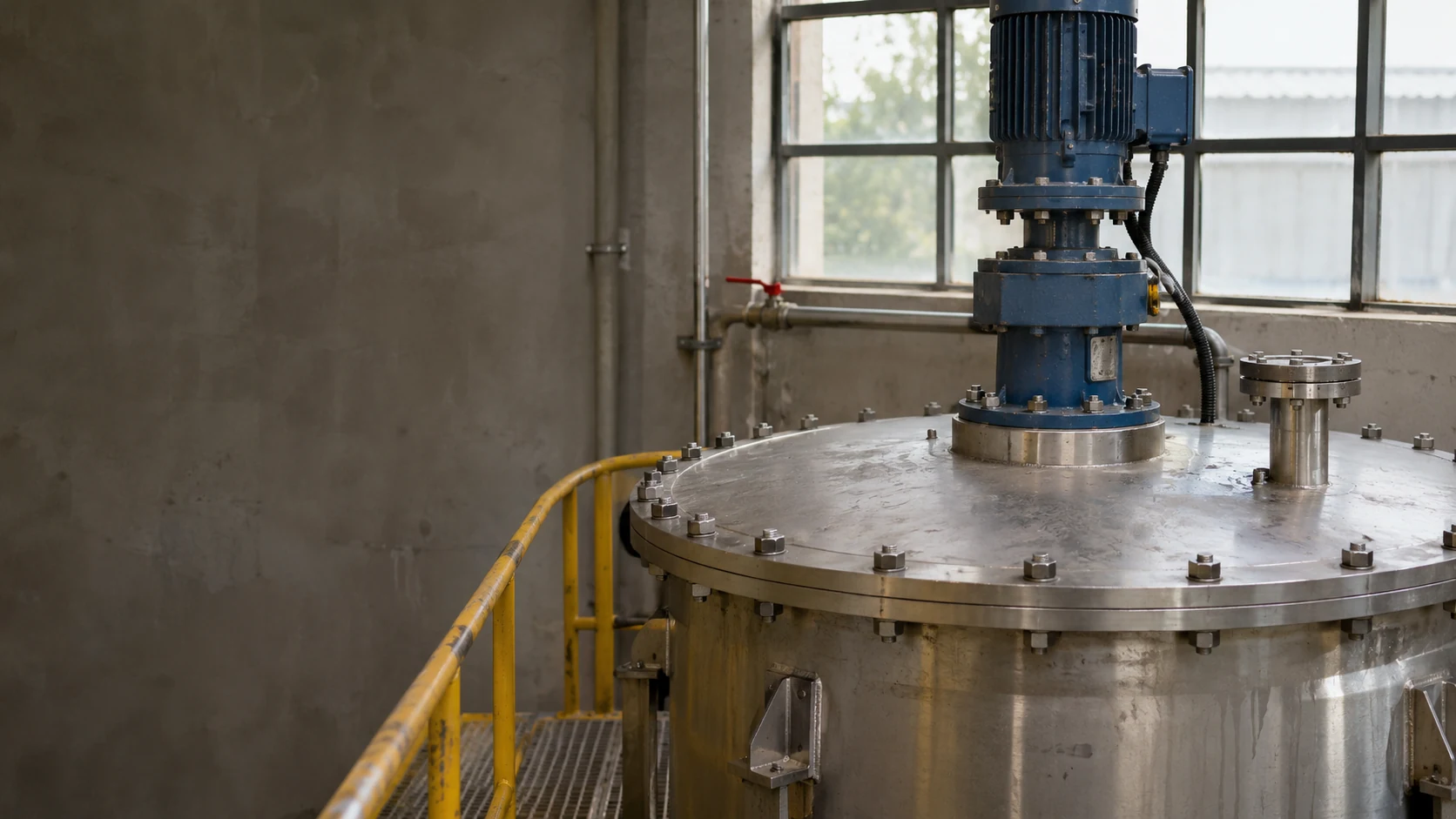
That pit is a joint failure, not a material failure alone. The stud alloy, the gasket seating load, and the last opening together decide whether the pit keeps growing or stops at the surface.
Order a reactor cover stud set as a set, not as a material name. A set ordered by grade alone leaves the gasket, the length, and the nut to chance, and a cover that opens every campaign exposes each gap in turn. The cover, the gasket, the stud length, the matching nut, and the opening procedure belong on one order, since a cover opened, cleaned, and re-seated many times fails differently from a flange bolted once and left alone.
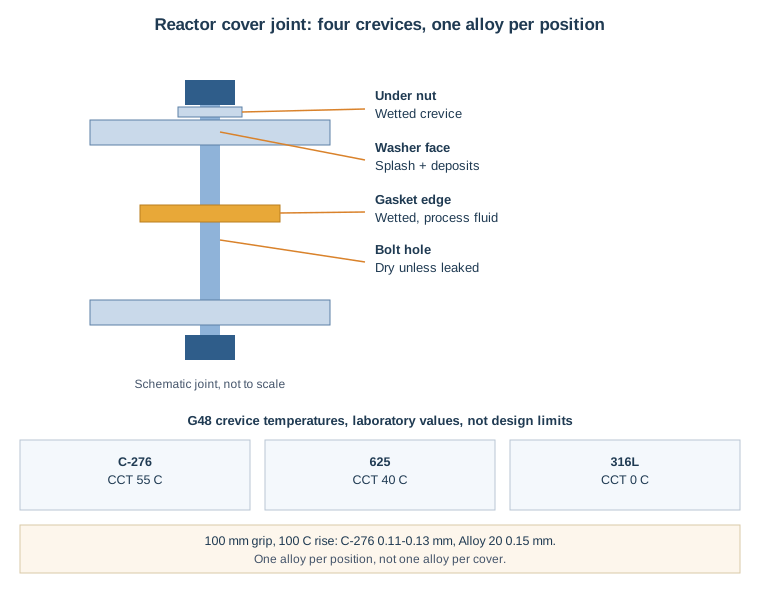
Figure: Reactor cover joint — four crevices with different exposures; G48 crevice temperatures are laboratory values, and the order states one alloy per position.
01 Mixed acid, crevices, and the cover that opens again
A reactor stream is rarely one clean acid. One batch can carry a reducing acid, an oxidizing species, and chloride in the same vessel, and the balance can swing between batches. An alloy that holds its protective film in one condition can lose it in another, and where chloride, stagnant liquid, or a change in acid character breaks the film, attack concentrates at that spot.
Crevices are where the film breaks first. Under a nut, under a washer, at a gasket face, or under a deposit, liquid sits still and oxygen-starved, and the chemistry inside turns aggressive while the open surface still looks sound. Every bolt hole, washer face, and gasket edge on a reactor cover is such a pocket, holding washdown liquid, retained process liquid, or condensate after the cover closes again. Haynes International's HASTELLOY C-276 alloy page describes outstanding resistance to pitting and crevice attack in chloride-bearing solutions, and to both oxidizing and non-oxidizing acids, with laboratory data across hydrochloric, hydrobromic, nitric, phosphoric, sulfuric, and hydrofluoric acids.
The same page reports a sharper comparison in acidified 6% ferric chloride under ASTM G48: a critical pitting temperature of 150°C and a critical crevice temperature of 55°C for C-276, against 100°C and 40°C for 625, and 15°C and 0°C for 316L. Those are laboratory test values in one aggressive solution, not design limits, and they show why a crevice temperature, not a general corrosion rate, often sets the cover decision. Before selecting an alloy, fix three items for each cover position:
- Identify the stream at each position: name the acids, the chloride level, the stud temperature, and whether the position sees washdown, condensate, or retained liquid after cleaning. A description that says only "mixed acid" names none of these.
- Map the crevices: list the bolt holes, washer faces, gasket edges, and deposit zones where liquid sits still, and mark wetted, splash, and dry zones on the position map.
- Record the opening interval: state how often the cover opens and what gets replaced at each opening.
02 The candidate alloys, and where each one stops
Hastelloy C-276, UNS N10276, bar to ASTM B574, is the usual starting point for a mixed-acid cover. Its nominal chemistry on Haynes International's HASTELLOY C-276 alloy page runs nickel 57% as balance, chromium 16%, molybdenum 16%, iron 5%, and tungsten 4%, with carbon capped at 0.010% and silicon at 0.080%. Molybdenum and tungsten carry the reducing-acid and chloride-pitting side, chromium carries the oxidizing side, and the low carbon and silicon keep weld zones from sensitizing. Solution-annealed C-276 bar carries ASTM B574 minima of 690 MPa tensile and 283 MPa yield, so size the cover joint around that modest yield, never by swapping like-for-like with a high-strength stud. Confirm the minima against the governing ASTM B574 edition.
C-276 is broad, not unlimited. Where the stream leans strongly oxidizing, for example hot concentrated nitric acid or a ferric-chloride-rich upset, check the higher-chromium C-22 grade for that upset. Where the acid is dilute sulfuric with no chloride or hydrochloric content, Alloy 20 can be the economical answer, but only inside its own concentration and temperature envelope. Inconel 625, UNS N06625, is a solid-solution alternative where oxidizing service dominates, but its chloride-pitting and reducing-acid limits sit below the C grades. Its ASTM B446 Grade 1 bar minima run 827 MPa tensile and 414 MPa yield to 102 mm diameter, and 758 MPa tensile and 345 MPa yield above that diameter, to be confirmed against the governing B446 edition. A 316L stud set, UNS S31603, is the boundary to avoid in this service: its G48 crevice temperature of 0°C in the Haynes comparison shows how early it pits and crevices in chloride-bearing mixed acid.
| Candidate | UNS and form | Where it fits a reactor cover | Boundary to watch |
|---|---|---|---|
| Hastelloy C-276 | UNS N10276, bar to ASTM B574 | Mixed and reducing acids with chloride, repeated opening | Strongly oxidizing upset; 283 MPa yield is the number the stud is sized from |
| Hastelloy C-22 | UNS N06022, bar to ASTM B574 | Oxidizing-leaning mixed acid, ferric and cupric chloride | Less reducing-acid strength than C-276 where hydrochloric acid dominates |
| Inconel 625 | UNS N06625, bar to ASTM B446 Grade 1 | Oxidizing service, higher annealed yield for seating | Reducing-acid and chloride-pitting limits below C-276; confirm Grade 1 minima against the governing B446 edition |
| Alloy 20 | UNS N08020, bar to ASTM B473 | Dilute sulfuric, no chloride or hydrochloric content | Mid-range hot sulfuric and chloride-bearing mixed acid beyond its envelope |
| 316L | UNS S31603, bolting to ASTM A193 B8M | Mild service only, not a mixed-acid cover | G48 crevice temperature 0°C; pits and crevices early in chloride-bearing mixed acid |
Thermal expansion deserves one quantified check on a mixed-alloy cover. Haynes International's HASTELLOY C-276 alloy page gives a mean coefficient of 11.2 µm/m·K over 24–100°C, rising to 13.1 µm/m·K over 24–400°C, while Carpenter Technology's CarTech 20Cb-3 datasheet gives 8.16 × 10⁻⁶ in/in/°F over 77–212°F, about 14.7 µm/m·K, for Alloy 20. Over a 100 mm grip and a 100°C rise, the C-276 side grows about 0.11–0.13 mm across that band and the Alloy 20 side about 0.15 mm, so a mixed set on one cover unloads unevenly on heating, and the order must state one alloy per position, not one alloy per cover.
ASTM B574, B446, and B473 are bar specifications, not finished-stud specifications. State the finished-stud dimensions for flange bolting per ASME B16.5, the thread form, such as UNR or UNJ rolled threads, and the thread rolling sequence relative to final heat treatment on the order. For these solution-annealed grades there is no ageing step, so the order names the annealed condition and the thread form rather than leaving either to the shop.
03 Repeated opening changes the failure, not just the alloy
A cover that opens every campaign wears its studs in ways a one-time flange does not: thread damage, washer-face scoring, and a nut that no longer runs freely at each opening, and a gasket that seats unevenly at each re-seating, since one stud in the circle has stretched, galled, or lost preload. Galling is the assembly risk to name: nickel-alloy threads can cold-weld and tear when the same alloy turns against itself under load, so the thread surfaces lock and the torque reading stops telling the truth about preload. Bossard's technical note on galling describes the oxide-breakdown sequence for stainless threads; apply the same lubricant discipline to nickel-alloy threads.
Fix the opening procedure with the set, not after it:
- Specify the lubricant: name the approved lubricant and check it against any copper, graphite, or halide ban in the process area.
- Fix the tightening sequence: state the sequence around the cover and whether torque or torque-angle is used. Torque-angle, tightening to a stated torque and then turning the nut a further stated angle, gives a more repeatable stretch than torque alone where friction varies.
- Record replacements by position: log which studs were replaced at each opening, and inspect removed studs by position. Pitting under the nut, pitting at the washer face, thread damage, and any stud that needed cutting each point at a different fix.
- Read the failure pattern: a set that pits only under the washer needs a washer, crevice, or lubricant change, while a set that pits everywhere needs a different alloy or a different stream description.
04 Define the set: wetted parts, length, and matching nuts
A reactor cover set is not one stud size repeated around the circle: some positions sit in the wetted zone, some in a splash or condensate zone, and some dry outside the gasket, and the alloy and inspection interval can differ by position inside one cover. State the gasket type and thickness, the washer type, and whether a washer is required under the nut, since the gasket stack decides the grip length: the length of stud that must span the cover, the gasket, the washer, and the nut, with enough thread left for full nut engagement.
Stud length is where a correct total length still fails: a stud long enough overall but short on usable thread at the nut end will not seat the gasket evenly, and a stud long at the nut end but short in the cover thread will pull out of the tapped hole. Give the cover thickness, the gasket stack, the washer thickness, the nut height, and the required thread engagement at each end, dimension both ends on the drawing, and state the nut alloy, UNS, and condition separately. A C-276 stud with an unstated nut is not a set, and a nut of a different grade can change the crevice, the galvanic picture, and the galling risk at the joint.
Send the stream description, the cover drawing, the gasket stack, and the opening interval to the BYBOLT engineering team for a check before ordering. That check is where a C-276 set is caught undersized for the cover load, a nut pairing is caught that changes the crevice picture, or a stud length is caught that seats the gasket on one side of the cover and not the other.
At receipt, the BYBOLT quality pack ties each stud set to its heat, its solution-annealing record, and its hardness report for the finished condition. Ask for EN 10204 3.1 certificates, a dimensional report for the actual studs, and a PMI report where the project requires it. A bar certificate alone does not prove the finished stud meets the condition the cover was sized on.
| What to lock before ordering | Why it changes the joint | Document to ask for |
|---|---|---|
| Stream per position: acids, chloride, temperature | Decides C-276 versus C-22, 625, or Alloy 20, and the inspection interval | Stream datasheet, per position, stud temperature stated separately |
| Wetted, splash, and dry positions | A dry-side stud does not need the same inspection as a wetted stud | Cover position map, set list by position |
| Gasket stack, washer, and nut height | Decides grip length and usable thread at each end | Drawing with gasket stack and both ends dimensioned |
| Nut alloy, UNS, and condition | An unstated nut changes crevice, galvanic, and galling risk | Nut standard and condition on the certificate |
| Lubricant, tightening method, and opening interval | Galling and uneven seating ruin a sound alloy choice | Approved lubricant list, tightening procedure |
| Set list and records | Mixed sets on a cover cannot be audited after a leak | Set list by cover position, EN 10204 3.1 certificates, PMI where specified |
05 Ask for a quote with the cover, not just the grade
If a reactor cover is being re-specified, or if a C-276 set is being considered to replace a pitted stainless set, send the cover with the size. A note like "M20 Hastelloy C-276 stud-and-nut set for a chemical reactor cover, mixed sulfuric and hydrochloric acids with chloride, 120°C stud temperature, gasket stack to be confirmed from the drawing, 16-bolt set, opened every campaign" gives the BYBOLT engineering team enough to check alloy, length, nut pairing, and opening procedure before quoting. A photo of a removed stud, showing pitting under the nut or washer, helps show whether the last failure started in a crevice, at the washer face, or at the gasket edge.
That note, plus the drawing if you have it, is enough to start. The team will fill in the missing stream, temperature, or engagement details with you, and quote a small batch or a full set with EN 10204 3.1 traceability.