
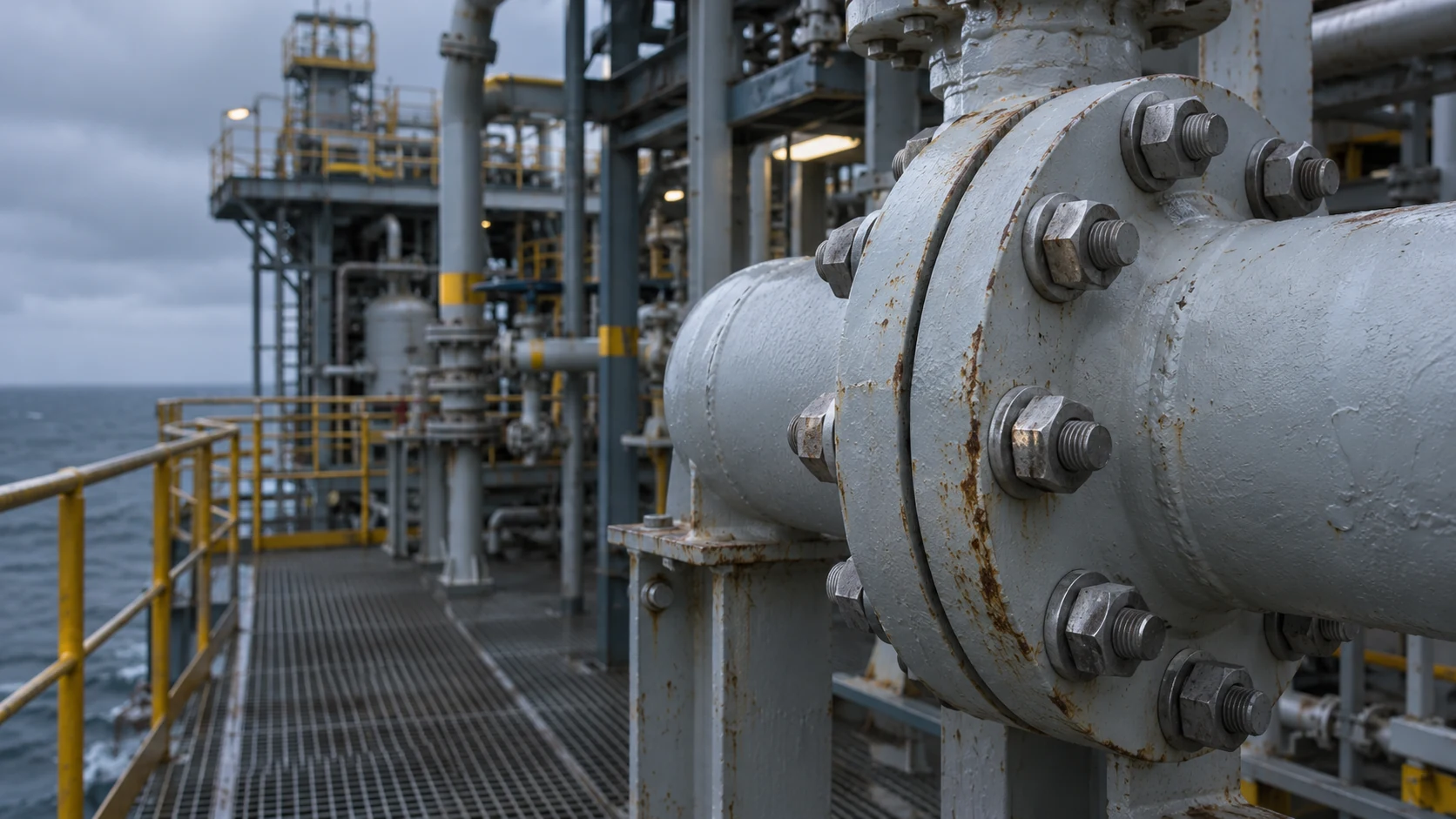
This guide treats a 625 stud set as a set, not a pile of studs. Exposure decides the alloy, fit decides whether the set can actually clamp the flange, and traceability decides whether the buyer can prove, months later, which heat and which test record belong to the studs in that flange.
Map exposure per location before choosing a grade. One word like "seawater" does not describe a thread crevice and a gasket edge at the same time.
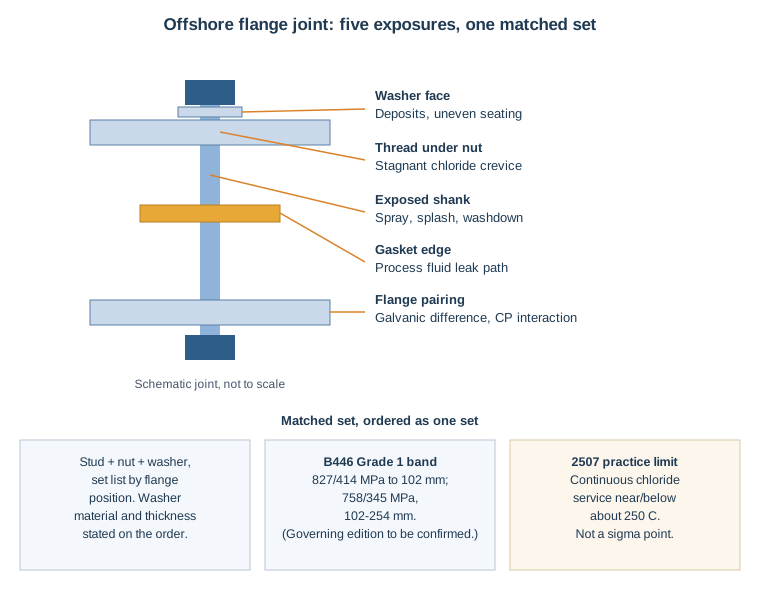
Figure: Offshore flange joint — five exposures set the alloy, washer, and set list; the stud set is ordered as one matched set.
01 Where seawater actually reaches the stud
A flange stud has more than one exposure, and the worst one is rarely the outside of the shank. The exposed shank sees spray and splash. The thread under the nut sees a tight crevice where oxygen is low and chloride concentrates. The washer face sees a second crevice, plus deposits and, on some topsides joints, washdown chemicals. The gasket face sees process fluid at the inner edge, and any leak path that reaches the stud circle.
Damage hides under the nut for a simple reason: a tight, oxygen-starved crevice traps stagnant chloride, the chemistry inside turns aggressive, and attack concentrates there while the open surface still looks fine. Liquid drawn into the thread clearance concentrates further as it dries, so the thread root sees a far stronger chloride load than the nominal seawater outside the joint.
| Joint location | Main risk | What the stud set order must state |
|---|---|---|
| Exposed shank, splash zone | Spray, salt deposits, washdown chemicals | Alloy, surface finish, coating or lubricant approval |
| Thread under the nut | Crevice attack, stagnant chloride, galling | Nut alloy and condition, thread class, approved lubricant |
| Washer face | Crevice attack, deposits, uneven seating | Washer material and thickness, flat seating face |
| Gasket edge and stud circle | Process fluid leak path, temperature, chloride | Process fluid, stud temperature, gasket type |
| Flange face pairing | Galvanic difference, cathodic protection interaction | Flange material, cathodic protection system, isolation need |
If the joint also runs hot for long periods, add stud temperature to that list. Bolt Science's stress-relaxation technical page describes preload loss with no rotation of the fastener, so a joint can lose clamp load at temperature even when no nut has turned.
02 Why 625 fits this joint
Inconel 625, UNS N06625, is a solid-solution nickel-chromium-molybdenum-niobium alloy, strengthened by molybdenum and niobium in the matrix rather than by ageing precipitates. Special Metals' INCONEL alloy 625 bulletin gives nickel at 58% minimum, chromium at 20–23%, molybdenum at 8–10%, and niobium plus tantalum at 3.15–4.15%. The high molybdenum content supports resistance to pitting and crevice attack in chloride fluids, while the high nickel content supports resistance to chloride stress corrosion cracking, where a crack grows under tensile stress in chloride service.
Size the joint for annealed strength. Under ASTM B446, Grade 1 annealed bar carries minima of 827 MPa tensile and 414 MPa yield up to 102 mm, dropping to 758 MPa tensile and 345 MPa yield from 102 to 254 mm, to be confirmed against the governing B446 edition on the order. That is far weaker than aged 718, so a 625 set must never be swapped like-for-like for a high-strength set on matching dimensions alone.
ASTM B446 is a bar and material specification, not a finished-stud specification, so thread, dimensions and finished-part testing still need stating separately. Finished studs are dimensioned per ASME B16.5 or the project drawing, with UNR or UNJ rounded-root thread form stated, and the order states whether threads are rolled before or after any final heat treatment.
Two boundaries belong here. First, 625 is noble relative to carbon steel: where the two metals meet in seawater, the less-noble carbon steel becomes the anode and corrodes preferentially at the contact. Check galvanic pairing and cathodic protection, and state whether isolation or a compatible washer is required. Second, a 625 stud in a hot, chloride-rich crevice still needs the actual temperature and chloride level stated on the order.
03 Fit and set: the parts that make a stud set work
A stud set is studs, nuts, and washers made and checked to work together. Start with length. A flange stud needs enough thread at each end for full nut engagement, plus gasket compression travel, plus tool access. A stud too short leaves the nut on only part of its height. A stud too long fouls insulation, a guard, or the next pipe run, and tempts the crew to cut it on site, which destroys traceability and thread finish in one step.
Thread condition and lubricant complete the fit. Write galling control into the tightening plan: Bossard's galling technical note describes how the protective oxide layer breaks down under surface pressure until bare metal surfaces lock together. Name the approved lubricant, the tightening method, and the sequence, so a torque reading still means something about clamp load.
Washer faces deserve the same attention as threads. A washer that seats unevenly, or a washer material that cannot survive the joint chemistry, leaves the nut face loaded on one edge and the gasket short of seating stress on the opposite side. State washer material, thickness, and flat seating face on the order.
04 Compare 625 with the grades buyers often consider instead
| Alloy and standard | Strength picture | Offshore flange note |
|---|---|---|
| Inconel 625, UNS N06625, ASTM B446 Grade 1 | Annealed; B446 minima of 827 MPa tensile and 414 MPa yield up to 102 mm | Best fit where corrosion and crevice attack govern, and the joint is sized for annealed strength, not swapped like-for-like |
| Super duplex 2507, UNS S32750, ASTM A479 / A182 F53 | High strength for a stainless grade | Hold continuous chloride service near or below about 250°C; above that band, toughness and corrosion resistance fall; see the limit note below. Not a direct 625 substitute in every crevice |
| Monel K-500, UNS N05500, ASTM B865 | Age-hardened, higher strength than Monel 400 | State the aged condition and hardness on the order; state flowing versus stagnant seawater service; check crevice and stagnant-service limits |
| 316L stainless, UNS S31603, ASTM A193 B8M / ISO 3506 A4 | Low strength, familiar and low cost | Pits and crevices in chloride service far sooner than 625; a low-cost swap that often costs a shutdown |
| Inconel 718, UNS N07718, ASTM B637 | Aged, very high strength | Use where load governs and the corrosion-table entry for 718 is met; AMS 5662/5663 gives at least 150 ksi (1,035 MPa) yield, while sour-service sizing uses 827–1,034 MPa per API Spec 6ACRA (formerly API 6A718) / NACE MR0175 / ISO 15156 with hardness inside the entry band, commonly stated 32–40 HRC, to be confirmed against the governing edition |
Treat the 2507 limit near 250°C as a long-term practice limit for prolonged exposure, not a sigma point. Alleima's SAF 2507 tube datasheet states that prolonged exposure above 250°C changes the microstructure and reduces impact strength, and sets 250°C as the maximum for pressure-vessel applications under VdTÜV-Wb 508 and NGS 1609. Under cathodic protection, high tensile stress also raises hydrogen-induced stress cracking risk in super duplex grades, so the cathodic protection system and the stress level belong on the order with the temperature.
Send the flange material, the process fluid, the external environment, and the cathodic protection details to the BYBOLT engineering team for a check before ordering. That check catches a galvanic mismatch, a washer material unsuited to the joint chemistry, or a stud length that leaves the nut short of full engagement.
05 Traceability: proving which stud is in which flange
Offshore work lives on records. A stud set without traceability cannot be audited after a leak, a shutdown, or a change of operator. At receipt, match each flange position to a heat number, a finished-stud test record, and a set list, so no mixed set passes on a single certificate.
Ask for the pack by name.
- Identify the mill record: EN 10204 3.1 mill certificates tied to heat numbers, not just to a grade.
- Map the finished dimensions: A dimensional report for the actual studs, nuts and washers supplied, with thread form and length checked.
- Verify hardness and identity: A hardness report where hardness is specified, and a PMI report where the project requires it, with the test points stated.
- Record the set list: A set list grouping studs, nuts and washers by flange position, so the crew does not mix sets on deck.
| What to lock before ordering | Why it changes the joint | Document to ask for |
|---|---|---|
| Exposure per location, fluid, temperature | Decides alloy, washer and lubricant, not just a grade name | Joint exposure datasheet, per location |
| Flange material and cathodic protection | Decides galvanic pairing and isolation need | Flange material, cathodic protection system details |
| Stud, nut and washer as a set | A matched set clamps evenly; mixed parts do not | Set list by flange position, nut and washer standards |
| Length, engagement and tool access | Short engagement or fouled length ruins fit at assembly | Drawing with both ends dimensioned, dimensional report |
| Lubricant and tightening method | Galling or wrong friction leaves the joint under-clamped | Approved lubricant list, tightening procedure |
| Marking, packing and records | Unlabelled sets get mixed on deck and cannot be audited | EN 10204 3.1 certificates, PMI and hardness reports where specified, set labels |
If an offshore flange is being re-specified, or if a 625 set is being considered to replace a pitted stainless set, send the flange details with the size. A note like "M24 Inconel 625 stud set for an offshore process flange, seawater splash zone, carbon-steel flange, cathodic protection to be confirmed, 8-bolt set" gives the BYBOLT engineering team enough to check exposure, fit, galvanic pairing, and traceability before quoting. Even a photo of a removed stud, showing pitting under the nut or washer, helps show whether the last failure started in a crevice, at the washer face, or at the gasket edge.
That note, plus the drawing if you have it, is enough to start. The team will work through the missing exposure, engagement or lubricant details with you, and price a small maintenance batch or a full flange set with EN 10204 3.1 traceability, rather than asking you to guess the full specification first.