
A bolt that survives clean acid can fail in the same acid once chloride, ferric ions, or a hot stagnant pocket enter the line.
Write a sulfuric-acid bolt enquiry that states concentration, temperature, and contamination together. Leave any one of those out, and the bolt that arrives may fit the chart while missing the actual line duty. The enquiry is the specification: it tells the supplier which of the acid's several characters the bolt must survive. A supplier cannot judge whether the bolt on order sits inside the alloy's real envelope, or outside it in a way that only shows up at the next shutdown.
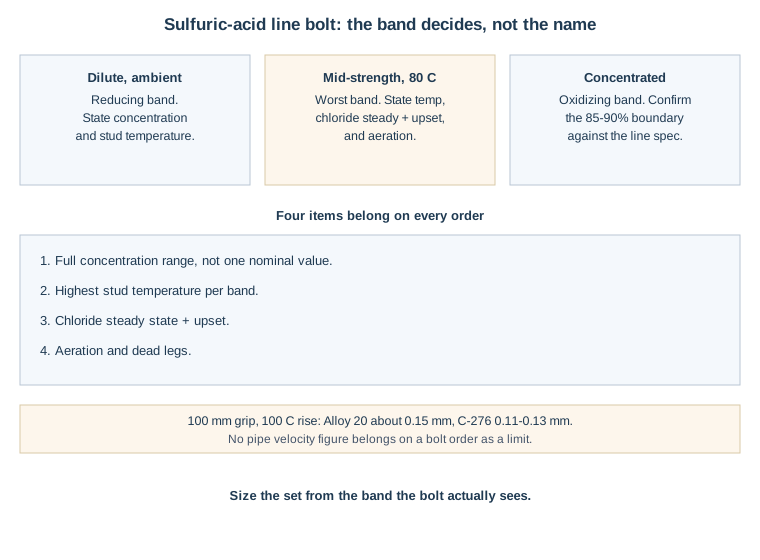
Figure: Sulfuric-acid line bolt — dilute, mid-strength, and concentrated bands set different order items; no pipe velocity figure belongs on a bolt order as a limit.
01 Concentration changes the acid, not just its strength
Sulfuric acid changes character with concentration. Dilute acid behaves as a reducing acid: it attacks the iron in a stainless matrix and strips the protective film that keeps the metal passive. Concentrated acid above about 85–90% behaves as a strongly oxidizing fluid and helps that film reform, which is why some alloys that fail in dilute acid hold up in concentrated acid; confirm that 85–90% band boundary against the line's acid specification. Between those two ends, in the mid-range, the acid is neither cleanly reducing nor cleanly oxidizing, and the corrosion rate depends on temperature, on chloride content, on dissolved oxygen, and on oxidizing ions such as ferric or cupric species.
The mid-range is where the evidence concentrates. Carpenter Technology's CarTech 20Cb-3 datasheet puts its stress-corrosion emphasis on boiling 20–40% sulfuric acid, and it warns that chloride ions increase attack while contaminants in commercial acid change the degree of attack away from reagent-grade chart values. Its iso-corrosion data carry no intentional aeration or deaeration, and the datasheet states plainly that corrosion resistance varies with impurities, aeration, heat transfer, velocity, crevices, deposits, metallurgical condition, stress, surface finish, and dissimilar metal contact. A single concentration number, without temperature, is therefore not a specification. A line that runs 20% acid at ambient temperature, 50% acid at 80°C, and 96% acid after a concentration step is three different bolt duties, even though the acid name never changes.
Fix three items on the enquiry before selecting an alloy:
- Identify the full concentration range: list every concentration the line actually sees, not one headline number. A bolt qualified at 96% has no standing in 50% acid at temperature.
- Map the temperature at each concentration: state the highest stud temperature inside each concentration band. Temperature widens the damaging mid-range band, and a stud temperature is not the same as a stream temperature.
- Record contamination at steady and upset levels: name chloride, ferric, cupric, and oxidizer ingress, each at its steady level and its upset peak. A bolt sized for steady chloride can fail on a peak.
02 The candidate alloys, and where each one stops
Alloy 20, UNS N08020, was designed for this middle ground. Carpenter Technology's CarTech 20Cb-3 datasheet gives its chemistry as chromium 19.00–21.00%, nickel 32.50–35.00%, molybdenum 2.00–3.00%, copper 3.00–4.00%, and columbium plus tantalum at 8 times carbon minimum to 1.00% maximum. Copper does the work in the reducing region: it slows acid attack where chromium alone cannot hold the film. Columbium stabilizes the grade against intergranular attack in welded joints by binding free carbon. Stabilized-annealed Alloy 20 bar carries ASTM B473 minima of 551 MPa tensile and 241 MPa yield, so size a hex bolt set from a stated condition rather than by analogy to stainless bolting. Confirm the minima against the governing ASTM B473 edition.
Treat any chart as a screening step before coupon testing in the actual stream where the duty is critical. Plant acid carries chlorides, fluorides, iron, and organic residues that move reagent-grade curves by a wide margin, and no single chart value is a design limit for a bolted joint.
| Candidate | UNS and form | Where it fits a sulfuric line | Boundary to watch |
|---|---|---|---|
| Alloy 20 | UNS N08020, bar to ASTM B473 | Dilute to mid-strength sulfuric, moderate temperature, copper-carried reducing duty | Hot mid-strength acid, chloride, and hot concentrated acid that runs deaerated |
| 904L | UNS N08904, bar to ASTM A479 | Dilute to moderate sulfuric with chloride, lower cost where the envelope fits | Narrower envelope than Alloy 20 in hot reducing acid; confirm against the acid specification |
| Hastelloy C-276 | UNS N10276, bar to ASTM B574 | Hot, contaminated, or oxidizing-ingress sulfuric, mixed acid | Higher set cost; check strongly oxidizing limits separately |
| 316L | UNS S31603, bolting to ASTM A193 B8M | Mild, dilute, cool service only | Corrodes rapidly in sulfuric acid at moderate temperature once concentration rises beyond dilute service |
Thermal expansion deserves one quantified check where Alloy 20 bolts meet a different flange metal. Carpenter Technology's CarTech 20Cb-3 datasheet gives a mean coefficient of 8.16 × 10⁻⁶ in/in/°F over 77–212°F, about 14.7 µm/m·K, rising to 8.84 × 10⁻⁶ in/in/°F over 77–842°F, about 15.9 µm/m·K. Haynes International's HASTELLOY C-276 alloy page gives 12.0 µm/m·K over 24–200°C for C-276. Over a 100 mm grip and a 100°C rise, an Alloy 20 bolt grows about 0.15 mm and a C-276 bolt about 0.12 mm. Heating therefore unloads an Alloy 20 set faster than a C-276 set on the same flange, and the order must state the bolt alloy with the flange metal, not the bolt alloy alone.
ASTM B473, A479, and B574 are bar and material specifications, not finished-bolt specifications. State the finished-bolt dimensions, the thread form, and the thread rolling sequence relative to final heat treatment on the order. Alloy 20 cannot be hardened by heat treatment, so the order names the stabilized-annealed condition and the thread form, such as UNR or UNJ rolled threads, rather than leaving either to the shop.
03 Contamination, aeration, and velocity decide the real envelope
Three contamination questions change an Alloy 20 decision more than the headline concentration does. First, chloride: chloride in sulfuric acid accelerates corrosion and localized attack, and it overrides a clean-acid chart. Chloride stress corrosion cracking is the loaded-bolt version of that attack: tensile stress plus chloride lets a crack grow in a bolt that would not crack unloaded. State the chloride limit in the acid specification, and state whether it is a steady level or an upset peak, since a bolt sized for steady chloride can fail on a peak. Second, oxidizing contamination: ferric and cupric ions, nitric ingress, or another oxidizer can shift the acid character and the film behaviour, in either direction depending on concentration, so an oxidizer entry on the datasheet is not a detail to leave blank. Third, aeration: state the aeration on the order. Carpenter Technology's CarTech 20Cb-3 datasheet bases its iso-corrosion data on reagent-grade acid with no intentional aeration or deaeration, so a line that runs deaerated needs its own check, not a chart reading.
Velocity and stagnation belong in the same list. Flowing acid washes a surface and helps the film rebuild; stagnant acid under a nut or washer, or in a dead leg, lets chloride concentrate and attack start in a crevice. State the line velocity, the dead legs, and the drain and washdown practice. Let the designer confirm whether the bolt sees flowing, stagnant, or alternating wet and dry service. A line that dries between batches re-forms its film differently from a line that stays wet. No pipe velocity figure belongs on a bolt order as a limit: velocity is a line condition to state, not a bolt acceptance value.
04 A hex bolt set is a bolt, a nut, and a condition
A sulfuric-acid hex bolt fails at the joint, not in a catalogue. State the bolt size and thread, the nut alloy and condition, the washer type, and whether the nut is the same grade as the bolt or a compatible grade approved for the line. A mismatched nut can change the crevice, the galvanic picture, and the galling risk, and a nut that runs freely in the workshop can still seize after acid exposure if the thread finish and lubricant were never approved for that service. Nickel-alloy and high-nickel stainless threads can cold-weld and tear when the same alloy turns against itself under load. Bossard's technical note on galling describes the oxide-breakdown sequence for stainless threads; apply the same lubricant discipline to Alloy 20 threads, and confirm the lubricant against the acid area's bans before relying on it.
Fix the assembly items with the set:
- Specify the lubricant: name the approved lubricant and check it against any copper, graphite, or halide ban in the acid area. An unapproved lubricant is a contamination event, not a convenience.
- Fix the tightening method: state whether torque or torque-angle is used. Torque-angle, tightening to a stated torque and then turning the nut a further stated angle, gives a more repeatable stretch than torque alone where friction varies.
- Inspect removed bolts by position: log pitting under the nut and washer, thread-root attack, and any bolt that needed cutting to remove. A bolt that pits only under the washer needs a washer, crevice, or lubricant change, while a bolt that pits everywhere needs a different alloy or a different acid description.
Send the acid description, the line drawing, the bolt size, and the operating range to the BYBOLT engineering team for a check before ordering. That check is where an Alloy 20 bolt is caught outside its concentration and temperature envelope, a nut pairing is caught that changes the crevice picture, or a bolt length is caught that seats the flange on one side and not the other.
At receipt, the BYBOLT quality pack ties each bolt set to its heat, its stabilized-annealing record, and its hardness report for the finished condition. Ask for EN 10204 3.1 certificates, a dimensional report for the actual bolts, and a PMI report where the project requires it. A bar certificate alone does not prove the finished, threaded bolt meets the condition the line was sized on.
| What to lock before ordering | Why it changes the joint | Document to ask for |
|---|---|---|
| Acid concentration range, not one number | Dilute, mid-range, and concentrated acid are different duties | Acid datasheet, full operating range |
| Highest stud temperature in that range | Temperature widens the damaging mid-range band | Process datasheet, stud temperature stated separately |
| Chloride, ferric, cupric, and oxidizer levels | Contamination overrides a clean-acid chart | Acid specification, steady and upset levels |
| Aeration, velocity, dead legs, and washdown | Flowing, stagnant, and wet-dry service differ | Line datasheet, velocity and drain practice |
| Bolt, nut, washer, and lubricant | An unstated nut or lubricant changes crevice and galling risk | Bolt and nut standards, approved lubricant list |
| Set list and records | Mixed sets on a line leave no auditable trail after a leak | Set list by flange position, EN 10204 3.1 certificates, PMI where specified |
05 Ask for a quote with the acid, not just the grade
If a sulfuric-acid line is being re-specified, or if an Alloy 20 set is being considered to replace a corroded stainless set, send the acid with the size. A note like "M16 Alloy 20 hex bolt set for a sulfuric-acid transfer flange, 30% acid, 60°C stud temperature, chloride to be confirmed from the acid specification, 8-bolt set" gives the BYBOLT engineering team enough to check concentration, temperature, contamination, and nut pairing before quoting. Even a photo of a removed bolt, showing pitting under the nut or washer, helps show whether the last failure started in a crevice, at the washer face, or at the thread root.
Send that note with the drawing if you have it, and the team will work through the missing concentration, temperature, or contamination details with you before quoting a small batch or a full set with EN 10204 3.1 traceability.